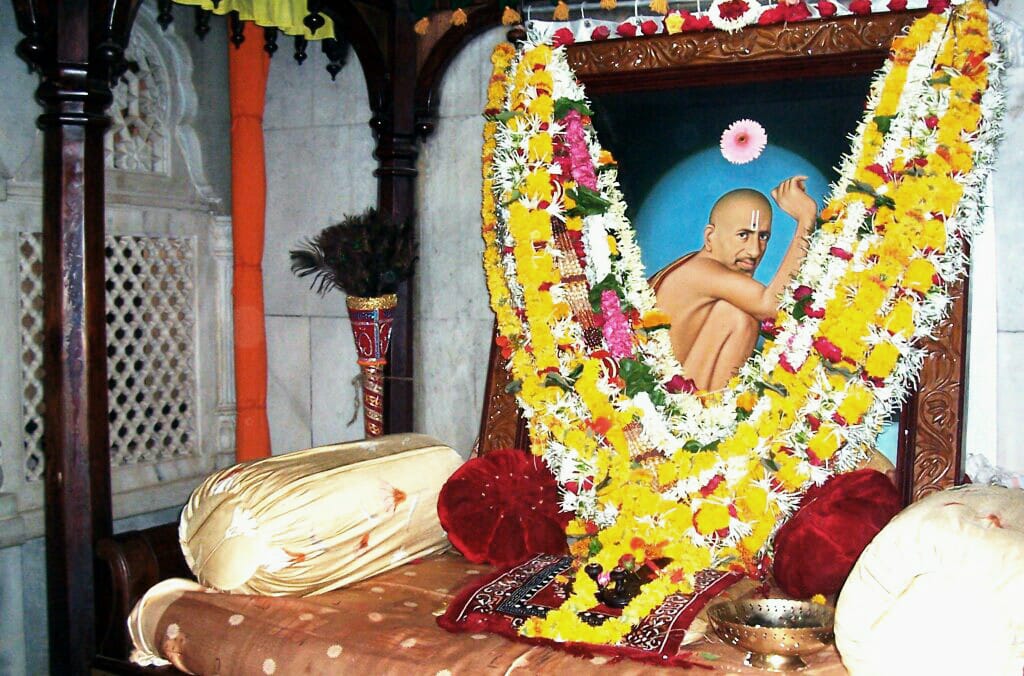
English translation of Adhyay 9. See the Glossary for special terms.
॥ Shri Ganeshay Namah ॥
1. O Ganapati, Saraswati — invitations should also (go) to the Devi; her presence is essential.
2. She is not asked just casually, only during Navaratri, only for self-interest, only for vows.
3. One who knows it should not be just for that — he calls again and again, keeps her remembrance daily, worships her daily.
4. How brave was Chhatrapati (Shivaji)! His support was on the Devi, on Mother Bhavani; by her grace he became great.
5. Through one, inspiration is obtained; another becomes active. The play runs on faith; by faith alone the soul crosses over.
6. Devi! Your forms are different; you give signs from time to time. Only by invocation do you come near; you protect in a critical hour.
7. O Devi of Kolhapur, may you hurry to my place. Saraswati causes the book to be written; in that, your help is needed.
8. O Dattatreya, I invite you too; let your feet be obtained. Let the writing of the book become sweet; not without your help.
9. Let the devotees obtain joy. Gana-Maharaj falls at the feet. Let your shadow of grace be there; thereby the soul is uplifted.
10. As is my asking, so was the kirtankar's. Govindbuva's was just so — he was begging for divine grace.
11. To do kirtan to give joy; to put on the path of devotion; to roam village to village — a vehicle had to be made.
12. As today there are motor cars and scooters, in earlier times one had to be a horse-rider. According to the times, so it is — but a vehicle is needed.
13. Once at the Mote family's Shiva temple in Shegaon, Govindbuva had come. He gave excellent kirtan; he made everyone absorbed.
14. Govindbuva came to Shegaon; he brought the horse along. The horse was indeed wicked; from time to time it bolted.
15. The vehicle should be in good condition, by which the rider is at peace in the heart. It is not in everyone's fortune; Govindbuva was one such.
16. Govindbuva's fortune was such — his horse was wicked. No name of peace; Govindbuva too was uneasy.
17. To make others absorbed, one must first become absorbed oneself. He knew in his heart: no right convergence without the Guru's grace.
18. The duration is fixed; no one can change it. By a saint's grace, what is the destined experience becomes bearable.
19. Govindbuva forgot the chain useful for tying the horse. He tied it with cord and rope; he said: "I shall experience peace."
20. The horse was neighing; jumping continued; Govindbuva was doing kirtan; his attention was not there.
21. When the kirtan ended, going to the residence, his mind was not at peace; the horse began to appear (in his thoughts).
22. The horse will not stay still; afflicted with disease and trouble; tormenting others. Govindbuva is never at peace.
23. The horse is naturally very wicked; it would kick people. With the horse's noise, how shall Govindbuva sleep?
24. The wickedness is of one; the nature of others is to remove it. This is the play of destined experience.
25. Such play goes on; common people make jokes and pranks. Saints remove (it) by yogic strength. The Master's was just so.
26. The Master got up at night; murmuring continued on his lips; he set out toward the horse; the neighing reduced.
27. He who chants "Gan Gan Ganat Bote" — he revels in each moment of it. He gets no peace; he lives only for others.
28. A benevolent one lives so; no name of stillness; he forgets himself entirely. The Master's living was thus.
29. According to the Creator's wish the Master shall live; but the action which shall happen — that shall prove to be a wonder itself.
30. The horse was neighing; was lashing kicks; to tell its grief, it was acting thus.
31. Maharaj got up; came near the horse; patted its back; he understood its grief.
32. The touch the horse received — it felt it; it seemed a person of love; the surge of love came.
33. The horse will neigh loudly; ever lashing kicks. Who shall not be afraid of it? Even the owner cannot control it.
34. The Master knows the principles; he has compassion on all creatures; he removes their lacks; he does not sit dwelling on them.
35. When the Master ran his hand gently on the horse's back, when a different touch was felt, the horse came to its senses.
36. Maharaj sat down; bent low; lay between the four legs; the neighing was banished.
37. Animals also have minds; not all agree to this. The Master knew it; he convinced through action.
38. The convincer must be worthy; the unworthy proves a fool and ineffective. He who is influential — he alone impresses on another.
39. Action (deed) needs to be influential. The Master's was just so. The horse had known; thereby it became calm.
40. The Master made just a touch; the wicked horse became calm. The Master's touch proved influential; the stigma on the horse was averted.
41. One who has impressed name-japa in every fiber of the body — in each of his actions, only influence is seen.
42. What Govindbuva tried by speech, likewise by company — to calm the horse — efforts proved fruitless.
43. The same the Master did by action, by gentle touch, did spontaneously, without any fanfare.
44. The wicked horse became calm; gave him the support of the four legs. He on whom love settles — it shall come thus to experience.
45. One who himself gives shelter — what kicks shall he lash? The soul who does deeds from the heart shall behave only with joy.
46. Here Govindbuva was lying down; the horse's neighing had stopped. He was astonished; impatient to look.
47. He came near the horse; was astonished. The kirtan-lessons learned by rote — he said: "All have gone to waste."
48. He was convinced in his heart; understood his own mistake. The dry preachings made never get digested.
49. He held the Master's feet; throat became choked; tears flowed from the eyes; the inner being became eloquent.
Govindbuva said to the Master:
"I wandered in vain, I roamed in vain.
I became a cause for kirtan;
I nourished the family;
I followed only book-knowledge.
The morsel I took close — by it no one's belly was filled.
This very life-span has gone half-done — what shall I say of the next life?
Belly-filling has never come about; the mind has remained ever unsatisfied.
He who could not pacify a horse — what has Govindbuva understood?
I did not know another's grief; I did dry, useless treatments.
The kirtan-lessons recited by rote did not prove useful in practice.
It became mere learnedness; personal experience did not fall in my lap.
Life became remorse; thereby I have held the Master's feet.
I have asked for the gracious blessing; you alone shall do the welfare."
50. When remorse comes, such utterances come out. Some support is taken; thereby life crosses over.
51. The Master took him near; made him wise immediately; told the whole essence; said: "Let faith be unshakable."
52. The Master gave instruction through action — not through mere speech. Taking Govindbuva near, he uplifted him.
53. The Master instructed him: don't give from your own pocket; don't forget the important; know another's sorrow; lighten it.
54. Don't have mere knowledge in front; have it in the karma of duty. That alone is useful in worldly life — but with detached behavior.
55. "Gan Gan Ganat Bote" — the secret was being told: the soul's relationship with Brahman; it shall not be separated.
56. The soul is not separate from Brahman; it is its very fragment, not understood by all. He who pervades all moving and unmoving — that has become his.
57. The Master knows all — what is in another's mind, the very inner being. He convinces through inner-knowledge.
58. Selfish people, when they are frightened in a situation, make whatever vows; they make pleas to God.
59. When the work is done they forget; sometimes they push it off; they practice their original nature; they behave conveniently.
60. The Brahmins of Balapur, with some motive in mind, came for darshan, saying: "Let us achieve the motive."
61. No one comes for darshan in vain; each is hungry for his own self-interest, not for the spiritual.
62. One who knows only self-interest takes the opportunity; he is calculating; he behaves so.
63. The awakened need not be awakened — the Master knew. But those who turned a blind eye, he was bringing to awareness.
64. Those who are asleep — them alone he alerts. Those who come to him — they remain having become his.
65. What greatness of mind! While making another his own, no sorrow or torment, just spontaneity.
66. That does not come by teaching; it must be inborn; sometimes it happens through heart-touching realization. That is what is seen from time to time.
67. To bring another to senses — this is the Master's behavior; living with the feeling of "ours," firmly in nature.
68. People themselves are unwary; they declare the yogi unwary. Those who behave so shall meet disgrace.
69. Maharaj's vow of silence — in awakening another, in giving an ear-opening — was always actively engaged.
70. Such are this Master's actions — always for the awakening of people; they strive only for this; consider it their duty.
71. The Brahmins of Balapur made a vow of ganja. When their work was done, the vow was forgotten.
72. Those who know how to make a vow have not learned to fulfill it. Work being done, they forgot — what is usual happened.
73. Those who do not know the principle — how shall they realize the mistake? They will only make vows, forget to fulfill them.
74. Here too the same happened with them. They forgot to fulfill the vow; they tied a knot in their cloth — "Next time it will go well."
75. Again and again for darshan, they forgot to fulfill the vow. The Master came to know; he brought it to (their) attention.
76. What shall this naked Baba understand? What knowledge shall he have? So the Brahmins thought — but they experienced something different.
77. The Master told them: "Don't forget the vow. Next time bring the ganja; not just knots in your cloth."
78. The Brahmins were astonished; held the Master's feet; they realized the importance of others; thereby behaved (rightly).
79. "Hold the feet" — it need not be told; they get held spontaneously. All depends on action, on the influence of action.
80. When (the Master) is remembered with earnestness, the Master gives darshan. Forgetting caste and class, they remain having become his.
81. So should one remember — what shall not happen by darshan? He who shall not have darshan — there is some lack in his worship.
82. He who shall have darshan — his devotion is from the heart. Knowing the inner being, the Master gives darshan.
83. Don't merely do worship without the resolve of darshan. Whatever is obtained in darshan — does not get convinced without experience.
84. In darshan all is obtained — what is obtained in meeting. That is not obtained in correspondence. By experience all is convinced.
85. As is the wish in the mind, so it becomes in conduct; that very (thing) bears fruit in experience. To the wish for joy, joy.
86. Don't pointlessly blame the Lord. He whose mind has pure motive — fortune arises; he alone is fit for darshan.
87. To whom should one give? One should give to the worthy. The Lord knows; how shall he forget the principle?
88. The Lord's mistake shall not happen; he shall seek out only the worthy; shall give at the right time; shall not give for free.
89. Balkrishna of Balapur knew in his heart; doing the service of Ramdas, he was living his life.
90. Putalabai — his wife, devoted spouse in heart. It was visible in her actions; it would unfold from her inner being.
91. On Paush Krishna Navami, Balkrishna would set out from Balapur; with his wife on the pilgrimage, would go to Sajjangad.
92. Taking finger-cymbals in hand, he would become absorbed in bhajan. The wife too kept him company, taking jhanj-cymbals in her hands.
93. "Raghupati Raghav Rajaram" — the Name of Ram came from the lips. Leaving one village after another, he reached his stay on foot.
94. Shegaon, Khamgaon, Mehekar, Jalnapur, Jambnagar — covering distance on foot, on the strength of resolve.
95. Jamb — the place. Birthplace of (Ramdas) Samartha. Staying three days, he would set out to the next village.
96. Then Beed, Ambejogai, Mohori, Domgav. Remembrance of Samartha occurred; the next steps were placed.
97. Narsingpur, Pandharpur, Nate-Pote, Singanapur, Wai and Satara — he would come to the foothills of the fort.
98. On Magh Krishna Pratipada (first day), he would come to Sajjangad. Staying for the festival, he would obtain joy.
99. The routine continued for many years; he went to the festival every year. At the age of sixty, the body began to tire.
100. On Magh Krishna Ekadashi, he sat near the samadhi; tears of sorrow in the eyes; he expressed his feeling.
101. "O Sadguru-Lord Samartha — at age sixty, the body has begun to tire now. How shall I do the foot-pilgrimage now?
102. Even sitting in a vehicle, to come to Sajjangad — even that seems difficult, a great obstacle.
103. Now the pilgrimage shall not happen; now distance shall fall (between us); now the body has tired. This is my anxiety.
104. You know all; you take devotees near. You alone, find a way now; you alone shall prove the savior."
105. Let Balkrishna invoke Ramdas; let Ramdas recognize the feeling; let him shower grace upon him; let it prove a marvelous convergence.
106. He prayed in his heart. As Balkrishna fell asleep, in the early morning, in a dream, Ramdas gave darshan.
107. Ramdas said to Balkrishna: "Now the body has tired; don't do the pilgrimage on foot; don't (have) anguish to the body.
108. The feeling in your inner being — that has been understood by us; the earnestness of darshan in your mind — thereby a convergence for darshan.
109. Don't come to Sajjangad. Stay at Balapur. Next year for the festival, I shall come to your place."
110. The words Ramdas shall speak — he shall make them true. Balkrishna knew this. Why shall he not stay joyful?
111. The next day dawned. Balkrishna set out back; he kept looking back, again and again.
112. "Now when shall my convergence come, of going to Sajjangad?" The worry — Ramdas shall save the devotee.
113. Watching, watching, the year passed. Ramdas's words echoed in his ears. The second year dawned. It was decided to do the festival at home.
114. Preparations began. The Master's image began to appear; the figure began to be drawn in his dream; he was so absorbed in it.
115. The atmosphere of Sajjangad — his mind would run there. He would be in contemplation in such a moment. How shall the mind revel in the home?
116. One who forgets house and home, who forgets himself entirely, who becomes absorbed in him (Ramdas) — he behaves thus.
117. Ramdas and Balkrishna — they were not two separate beings. Extraordinary oneness — the Lord knew in his heart.
118. The Lord sent Gajanan in the form of Ramdas to his home for the Dasnavami festival, to fulfill the wish in his mind.
119. Such a wonder occurred. The day of Dasnavami dawned. Balkrishna was caught up in (the spirit of) Das, became absorbed in the festival.
120. Body's affairs continued; mind was caught up in Das. Ten o'clock in the morning came; watching, watching, eleven o'clock came.
121. The mind reached the peak; for a moment got confused; nothing further was visible — only Sajjangad was visible.
122. The villagers gathered for the festival; they were watching Balkrishna. At his eccentricity, some were laughing at him.
123. What secret shall they know? Personal experience alone is supreme. He who is of equal stature — he alone shall understand all.
124. The wife knew everything; she gave him support. She was a devoted spouse, intent on dharma; daily catching her husband's words.
125. By the merit of the devoted spouse, by Balkrishna's devotion, by the strength of faith and earnestness, the Lord became pleased.
126. Seeing the right time, he shall give darshan. The Lord and Balkrishna — both were watching for such a moment.
127. They were waiting for that moment, for one right convergence, for the joy of darshan, for meeting each other.
128. Where the Lord watches, what splendor shall he not arrange? It must be in fortune; he does not watch in vain.
129. The Lord gave inspiration to Maharaj: "Go to Balkrishna's house, becoming Ramdas."
130. The yogi must obey; he went to Balkrishna's house, exactly at noon time, to give darshan.
131. The Name-resounding had begun. Men, women, child-gathering — they had raised the Name-call of Ramdas. Just then a tone joined in.
132. "Jay Jay Raghuvir Samartha!" Watching, watching, the powerful yogi stood at the door, in the form of Ramdas.
133. Balkrishna became motionless; for a moment got confused; began to look toward the door — Ramdas had come to his home!
134. The gulal and abir nearby — what shall he toss on the image? With Ramdas in person before him, he tossed them on the Master.
135. Now Gajanan appears; now Samartha's feet (appear). His mind became confused, seeing both forms.
136. Hubehub Ramdas (in person), in person at his house. The promise given — he came to keep it.
137. A question rose in his mind: "Which form should I accept?" He watched the leela, the Master's wonder.
138. At that very moment it came to mind: "Ramdas has fooled me; put me in confusion; sent Maharaj."
139. He convinced himself thus; the next program took place; what was in his mind did not go; it kept rolling around all day.
140. The day passed thus. Balkrishna was tired; he went to sleep just so. He began to think many thoughts.
141. Sleep would not come; what was before the eyes would not go. Now he sees Gajanan; now Ramdas's feet.
142. Ramdas came in the dream; said to Balkrishna: "'He' and 'I' are not separate. He who came to your home —
143. See me in him. The 'I' who is at Sajjangad — the same one is at your house. Impress this on the mind.
144. 'Samshayatma vinashyati' — this proves to be the true saying. Living on faith, you shall obtain good fruits.
145. Banish doubts from the mind; do not roam wildly. He alone has set the spread (of creation). Know this teaching as true."
146. Balkrishna's fortune arose, because of his mind's earnest longing. May our earnestness be likewise; fortune shall arise.
147. In nineteen hundred eighty-seven, on Magh Krishna Navami — the story of Ramdas Navami reached its completion.
148. This too was a right convergence — not deliberate. Written on Ramdas Navami; completed on Ramdas Navami itself.
॥ Shubham Bhavatu ॥
॥ Offered to Shri Ganapati and Saraswati ॥
॥ Thus ends the ninth chapter of Shri Guru Gajanan Leela Granth ॥