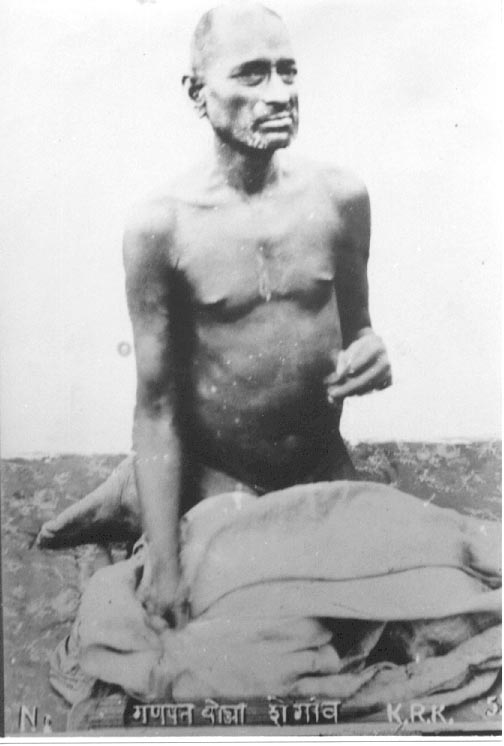
English translation of Adhyay 18. See the Glossary for special terms.
॥ Shri Ganeshay Namah ॥
1. O Parashuram, son of Jamadagni — I fall at your feet; hurry to (our) help.
2. You (appear) in different forms, in different incarnations. How shall I see (you) alone? You appear in many.
3. You take the test; you take the Vamana avatar; you pervade the whole world; leave nothing behind.
4. On which act of yours, on which form of yours, shall I keep faith — by which I shall experience peaceful consciousness?
5. You give many allurements; (you) allure the consciousness with that; entangle the consciousness in it; you alone divert (it).
6. (I) feel I shouldn't endure even a moment near you; you show many mirages; (I) feel I might be enchanted.
7. What greatness is this? You deceive my mind. How does (he) save the saints? — this is not understood by the mind.
8. You may be however; but I shall not abandon the principle. (I shall) call you to my place from time to time.
9. Saraswati has begun the celebration; you should come to take part; because of you, the celebration; joy shall be for all.
10. Come in different forms; increase the attendance; you must surely come; don't make (it) a disgrace.
11. People shall call me a fool; you shall protect (my) honor. Each devotee's mind is no different from this.
12. Be (he) anyone's devotee, the destined experience does not let go. When a difficult situation comes, then he shouts the call.
13. Such was a situation upon Bayja, upon one devotee of Mundgaon, upon one married woman, upon one chaste wife.
14. A situation of honor-protection, of one unwavering devotee, of her test of essence, of her chastity.
15. Of her future life, of her vow of chastity to her husband, of her virtuous conduct, of her religious faithfulness.
16. Other situations rest on one situation; from that itself many waves shall arise. By taking good company close, the situation becomes bearable.
17. One who becomes absorbed in devotion is sensible; he recognizes time and circumstance; behaves cautiously accordingly.
18. Steps are not placed cautiously; they are placed naturally. One who is awakened by devotion behaves naturally.
19. One who goes forward through darkness places his steps with care; places the burden on the one having faith; says: "You alone save."
20. So it was with Bayja, of one woman absorbed in name-japa, of a faithful woman, of one walking the right path.
21. But the brother-in-law's living was contrary, of one going toward darkness; (he liked) to revel in darkness itself; this he liked.
22. One who gropes in darkness stumbles on the way; loses his own balance; loses another's too.
23. He cannot see ahead; he loses awareness; (he) goes forward stumbling; only stumbling happens.
24. The opposite situation comes; the head bursts open. Then remorse comes, but proves meaningless.
25. Some reform by situation; some reform by contemplation; some have a useless life — by experience (they) do not become wise.
26. No one wants to bear destined experience; everyone wants destined experience to end.
27. Be (he) anyone's devotee, the situation is not avoided by anyone. He who overcomes the circumstance — he alone proves supreme in life.
28. That Bayja of Mundgaon, daughter of Shivram-Bhulabai, the devotee of the Master, was making the come-and-go of the Name.
29. Her Guru was Gajanan; faithfulness settled in heart; she reveled in him; forgot body-awareness.
30. Bayja's mother and father were not of her thinking; (they) behaved like the average; lived in worldly fashion.
31. Each couple feels: let offspring come without effort; let education be given to offspring; let marriage happen at the right time.
32. When Bayja came of age, she was married; (she) had to live in the customs; she did not escape that.
33. (She was) sent to the husband's, sent for garbhadhan; her stay was there; destiny refused offspring.
34. Living of the joint family, although of purity, no merit of the brother-in-law; the action proved sinful.
35. He was enamored of bodily pleasure, tormented by lust; lost his own balance; lost another's too.
36. Eager for one demonic pleasure, hungering for that very act, set out to do that — to sow the seed of misdeed.
37. He set out to kill virtuous conduct, virtuous behavior; forgot time and circumstance; forgot relationships.
38. He gave Bayja many allurements; she felt disgust at that disposition; she spat on him: "Burn (this) dead disposition of yours."
39. The elders of the house stood before her. She told the matter, but no one accepted (it).
40. The household was not convinced; all became angry; rather scolded her; something different came to experience.
41. The plate came before the brother-in-law; the prey itself in the home; he was joyful in mind; painted dreams in a moment.
42. To take a test of one brother-in-law and sister-in-law, of knowledge-ignorance, of sattvik-impure conflict, the start of facing began.
43. To make the onlookers eloquent, rather to teach them through that, to explain the importance of chastity, to make the chaste-wife dharma understood.
44. The doing was of destiny; her need was there; she alone tied the knot; she alone shall untie it.
45. One who has tied a knot — he alone can quickly untie it; for the hard to become easy, time must come; otherwise it does not come on call.
46. It comes only at the right time; convinces of its importance; is the doing of the Lord; one is to become wise from that.
47. One day the brother-in-law became lustful; was enamored of her form; held her hand; began to take her honor.
48. She said to the brother-in-law: "Let go, let go of me." Sweat broke out profusely on her; trembling came from fear.
49. She who was always absorbed in name-japa — what shall she revel in objects? In the brother-in-law's sinful act, in his allurement?
50. She made remembrance of the Guru: "You alone protect me. No one else shall come running for help."
51. Inspiration came to her; she said to the brother-in-law: "Those who reveled in objects met the dust.
52. You are like a father; don't behave wrongly so. Why such disgusting thoughts? Welfare lies in restraint.
53. Don't, don't (have) such play; passion in the mind shall grow strong; both's household shall break; two homes shall be destroyed."
54. While making the call to the Guru, the sound of a scream came; the Creator's call had come; the way of release.
55. The brother-in-law's son fell from the upper floor; was bloodied; a wound appeared on (his) forehead. Bayja ran to the call.
56. She was freed from the situation; was called chaste; the chaste-wife found voice; by virtuous-conduct proved virtuous.
57. The brother-in-law realized (his) mistake; the time of remorse came; the brother-in-law was disgraced; (he came to) a death-like state.
58. One should invoke; the other should reform. Live such a life; let it prove ideal.
59. Her mother and father learned; brought her back home; (their) hearts became heavy; before destiny nothing prevails.
60. The flesh-of-flesh that one has — looks beautiful in the home given to; should not be brought back; one should make adjustment.
61. Bayja's attention was-was-not in the house; (it) reveled in name-japa; the essence of life had been understood; (parents) did not approve of her behavior.
62. She became absorbed in name-japa; began to behave against mother and father; mother and father became weary; explained at every step.
63. No use was happening; no way was emerging. Someone proper was needed; there was none other than the Guru.
64. Someone suggested: "Only the Guru shall do welfare; by Guru Gajanan's grace, calamity certainly averted."
65. The thought convinced all; (they) came to Shegaon; placed Bayja at the Guru's feet; told all the news.
66. Told the motive of (their) mind: "Let Bayja have a son." The Master refused with a shake of head; informed (them) of her destined experience.
67. "Let her stay in name-japa." The Guru gave the order. All returned to Mundgaon, dejected, to home.
68. Bayja became absorbed; was under the Guru's command; was absorbed at the Guru's feet; could not live without the Guru.
69. From time to time she would go to Shegaon for darshan; sometimes Pundalik went as her companion.
70. What became a topic of discussion! The peak of pretense was reached. "The path of devotion is drowned in water; both have now overflowed."
71. Felt that both's pretense became cause for village-slander. "What kind of name-remembrance is this? This is enjoyment of objects."
72. Mother and father became weary; began to say whatever; "(They have) destroyed the home's honor"; began to call (her) "wretched of forehead."
73. In the maternal home itself, oppression like in-laws began for Bayja. May such (a fate) never come into anyone's destiny.
74. Bayja was bearing it quietly; had no awareness of sorrow; was quite in joy; had no other awareness.
75. Awareness itself had been lost; no need was to think; she was in thought of only one — was absorbed in Guru-contemplation.
76. When a person is absorbed in one, then no other thoughts. Bayja gives an excellent example, conveys (it) through action.
77. One who has not this contemplation — sorrow gives him pain. What the mother and father were experiencing — was known from speech.
78. Once again the mother and father — the torment became unbearable for them — came to Shegaon of themselves; said: "Master! You alone are mother and father now.
79. The torment is not borne; no way is emerging; new troubles in the home; the soul is wearied in it.
80. Pundalik (is) cause of trouble; comes always to Shegaon, as Bayja's companion. This is the village's gossip."
81. Maharaj smiled in (his) cheek. When-when Maharaj smiles, he laughs at ignorance, not at sorrow.
82. Laughter came at the ignorance, at the avoiding of destined experience, at making absurd accusations, by which (one) becomes sorrowful.
83. Destined experience ends by being borne; otherwise remains. (One) suffers in the next birth; nobody can avoid (it).
84. Whatever Maharaj shall say shall not please them. (They shall) return in disappointment; the play of hope-disappointment shall continue.
85. The Master said: "Listen to me. Don't raise doubts. Don't harass Janabai; her relationship is only with the Name."
86. He recognized Pundalik (as such): "He shall befit Bayja as a brother. Don't (have) wrong (thoughts) in mind." The Master told all.
87. So (he) protects Bayja. Such experiences come; many become free of torment, who remain having become his.
88. Such an experience for Bhau Kavar: once a boil came on him; medical treatment did not come to use; only tirth-angara came to use.
89. Bhau was surrounded by boil-disease; the illness reached extremity; medical treatments were done, but proved useless.
90. No relief came to the disease; sleep would not come peacefully; although many remedies were done, nothing came to mind for the household.
91. From a pimple a boil grew; from a spark flames came out; began to burn him; unbearable pain came.
92. The torment was burning him; the water of treatment was not extinguishing (it); Guru's grace was needed; (the situation) was conveying the Guru's greatness.
93. The boil was unbearable; eye would not catch eye; brother was as company, was doing nursing.
94. One night Bhau slept in the bungalow; brother was as company too. Sound of bullock-cart came; brother woke up.
95. Listened to the sound carefully; saw the bullock-cart; one man got down from it; came near the gate.
96. "I am 'Gaja,'" he said. "Maharaj has sent me, to give tirth-angara, to cure Bhau."
97. With faith later applied the angara; kept up the daily routine; Bhau became free of disease; afterward met the Master.
98. While looking at Bhau, refreshed memories: "Hey! you didn't put fodder for our bullocks, did you?"
99. The Master himself had given the tirth-angara — this was convinced to Bhau. Maharaj gives the sign to the devotee. Don't forget the principle.
100. Then the Master set out for Pandharpur, for the Ekadashi pilgrimage. Bapuna, Jagu, Aba went, Hari Patil, and fifty went on the pilgrimage.
101. Went to Nagjhari; began the start of the pilgrimage; took darshan of Gomaji; set forth in name-resounding.
102. Name-resounding was happening; (one) catching another's; one was taking color; was coloring another.
103. Each became absorbed; forgot the household atmosphere; became free of worldly life; began to sway in joy.
104. Reveling in Vitthal himself, dancing around Vitthal — as if at Pandharpur itself; absorbed in that very trance.
105. Stepping in trance; setting out to make gold of the human body; to wake up another; as if absorbed in bhajan.
106. Each village was passing; was hearing their words; was awakening; was mixing in with them.
107. (People) of different villages would join the bhajan, would enjoy the joy, would forget worldly torment.
108. In the atmosphere of enthusiasm, days were passing; without caring for sun and rain, going on the pilgrimage.
109. Women, children, big and small — absorbed in abir, bukka, gulal; would forget hunger and thirst — so absorbed in bhajan.
110. On Ashadh Shudh Navami came to Pandharpur; got down for stay at Kukaji Patil's residence.
111. Next day (they) bathed; set out for darshan; bhajan was going on the lips; abir and gulal were tossed.
112. The day of Ekadashi dawned; went to the river to bathe; Bapuna Kale also went there; kept dipping in the river.
113. He was late in coming; no one was ready to wait; each was eager for darshan; began to stand in line.
114. Began to walk the path of the temple; Bapuna remained behind just so. After a little while Bapuna came; he saw no one in the residence.
115. Bapuna became dejected; considered himself unfortunate; left from the residence for darshan; began to look for the companions.
116. While going by the path of the temple, while pushing-and-shoving was happening, while people were being crushed — Bapuna was watching the scene.
117. Some were searching; some were getting lost; tones of bhajans were coming forth; were combining together in the ear.
118. The sound of jhanj-cymbals loud was coming to be heard; mixed with another's speech in tone.
119. Chiplya (small cymbals), mridang, pakhwaj — all bring forth sweet sounds; gives ornament to the bhajan; that mixed-tone practice.
120. All were in effort; were in different joy; were eager for darshan; were pushing the one ahead from behind.
121. Garlands and packets of prasad were being twisted in (their) hands; each one's attention (was) on those, on protecting them.
122. More than even life he was taking care of those; each in the pushing-pulling, was protecting one's own.
123. In the twisted line, the influence of Brahmins (was) in it, in pushing those behind forward, in taking forward into the sanctum.
124. In such a situation, what shall Bapuna look at in the line? Vitthal himself was stored in (his) eyes; no one else was seen before.
125. Vitthal-darshan on Ashadhi Ekadashi, the Tirupati Balaji festival — when darshan is in fortune, only then will you tell of the experience.
126. But the picture there was different. The party had already pushed (themselves) forward in the crowd; were being impatient for darshan.
127. Each was in line by body, in Vitthal's darshan, but in mind in Bapuna; engrossed in his thought.
128. All was happening spontaneously; was the daily usual; nothing was fresh; at pilgrimage places, just so it happens.
129. One should go on pilgrimage with the mind; not just by body. Not all know; if known, ignored.
130. The convergence of darshan came; that (was) only by body, by pushing and shoving; not in mind.
131. Bapuna had become such a topic, the rain in the crowd was not felt; each was so absorbed in Bapuna; Vitthal was not seen by anyone.
132. They were tossed in the crowd; they did not realize it. Surface darshan happened; in that itself (they) considered (themselves) blessed.
133. Bapuna and the bhajan party returned to the residence; (they had) gone at small intervals; returned at small intervals.
134. In one's returning, the longing of darshan in it, the impatience of darshan in it, blaming (one's) destiny in it.
135. Others' darshan by body, slander of others by mind; such was their inner being, not absorbed in Vitthal.
136. All said to Bapuna: "What did your coming amount to? Vithoba's darshan didn't happen; you just saw Pandharpur?"
137. Bapuna undertook a fast; consciousness was caught in Vitthal alone; remained without darshan; began to make the mind uneasy.
138. Bapuna's longing — moment to moment grew rapidly; in mind-meditation Vitthal; only Vitthal he knew (as) all.
139. The hands of the inner clock were moving forward; name-remembrance was going on; the consciousness was caught in Vitthal.
140. The alarm of the inner clock at the time decided by the Creator shall ring without fail; everything shall happen according to time.
141. He who awakens others usefully at the right time, to take to the proper path — all the worry is the Creator's.
142. Watching, watching, the time came; the start of the alarm happened; began to wake up Bapuna; began to say: "Don't be dejected."
143. To the tone already set of the Name, the tone of fortune-rise joined; Bapuna's dawn happened; as if (Vitthal) had come to tell him.
144. Maharaj from his own seat became Vitthal himself, knowing Bapuna's longing; Vitthal came taking form.
145. Bapuna was confused for a moment: now Maharaj sky-clad, second time Vitthal's pitambar; goose bumps stood on his whole body.
146. Wearing many garments, with various ornaments, applied with sandal tilak, with tulsi-garland on the neck;
147. with eyes (looking as if) waiting, hands placed on the waist, with crown on head, standing right in his place;
148. waiting for one devotee, having forgotten time and circumstance, having forgotten body-awareness, absorbed in only one.
149. Around (him) saffron-sandal, the pleasant atmosphere of incense; from the lustre of thousand flames the lotus-face shone extraordinarily.
150. But not caring for anything — this very feeling was on his face. Bapuna absorbed in Kale; began to see Vitthal.
151. To the tears in the eyes, a flood came at that moment; while flowing down the cheeks, he could not control them.
152. Goose bumps stood all over the body; Vitthal himself began to appear; he was absorbed in trance; in a moment became awake.
153. Began to look around; began to tell the scene: "I saw the Vitthal of the temple. Is it just so at the temple?"
154. All became motionless; they said: "What did we see? Began to think; (we) felt (we are) trifling.
155. The deprivation of darshan, the feeling in the heart — Bapuna conveyed (it) to all; Bapuna became eloquent.
156. All said to the Master: "Show us Vitthal — the (one) you showed Bapuna; we don't want anything else."
157. Maharaj said to all: "The play of darshan does not run (so). Darshan happens because of longing, because of the inner-being's pull.
158. The darshan that (is) by body — joy is not obtained by it. The darshan that is by mind — joy is certainly obtained by it.
159. First become like Bapuna, by which (you shall) not (be) deprived of darshan. In the world there is nothing like longing."
160. Gana-Maharaj suggests here: by the steps of longing, by the pull of darshan, going to the destination happens.
161. As Bapuna on this pilgrimage proved worthy of Guru's grace, so a convergence of Guru's grace came to a Varkari of Kavathebahadur.
162. On Ashadh Shudh Dwadashi, all set out on the return, taking the overflowing joy with (them) home.
163. The cholera epidemic — (it) felt to come into (their) lot, the fortune of pilgrimage to rise, the fallen to be sanctified.
164. The Lord listened to the call; fulfilled her heart's desire; sent (her) to the pilgrimage to mix with the people.
165. She took shelter of the people; one by one was attacked; likewise the Varkari of Kavathebahadur — (she) did not let go of him.
166. Vomiting and diarrhea began; no strength remained in the body; cholera took (him) close; she surrounded him too.
167. The others' eyes were fixed on the path home; only the body had come along, joined by coincidence.
168. The program (was to) come and go, to happen as decided; there was no change in it; (it would) not change for one.
169. Only that much they had learned; that itself they kept following; began to whisper; began to look for what is convenient.
170. Here the same happened; nothing different from the world. The Varkari was attacked by the epidemic; all avoided him.
171. Said: "He is on the path of death; should not go on the journey; should stay right here at Pandharpur; should cure the illness."
172. Each was being cautious; was afraid of the disease; did not want obstacle in the journey; each was avoiding.
173. All set out to go; one or two were stopped; said: "(They) shall come later"; but it did not please the Master.
174. One who shall bring all together — how shall he exclude anyone? One who shall prove the support — that one alone shall give company.
175. Maharaj would take all close; would exclude no one. The fortune of that Varkari — the Master his companion.
176. He recognized the situation; the Varkari proved fortunate; proved worthy of Guru's grace; the Guru's support was obtained.
177. Maharaj went near; placed (his) hand on his head; gave him blessing; no cause of worry remained.
178. Took him near; drove away cholera; pushed Time far away; freed him of disease.
179. Such is the Guru's gracious gaze, the greatness of Guru's grace. All should practice such devotion, by which (one) attains Guru's gracious gaze.
180. All were filled (with emotion); shame happened; recognized the mistake; made up for the mistake.
181. All stopped; the Varkari was filled (with emotion); his disease became cured; all returned to Shegaon.
182. Of Bapuna's devotion, of the Varkari's cholera — became topics of discussion, situations of Pandharpur.
183. Maharaj came to Shegaon; many kinds of devotees met; (they) asked many questions; entreated the Master.
184. Once an orthodox Brahmin came to take darshan; on seeing the scene there, the mind became dejected.
185. Each was seen in Maharaj; absorbed in him; in one naked-mad (one), was catching spittle.
186. One who shall not know one word — what shall he know of the Vedas? On such (people) becoming praised, why shall the Brahmin not be irritated?
187. Coming to Shegaon, by stripping Maharaj naked, he wanted to show that Maharaj is intellect-zero.
188. Maharaj was in the math; he knew in the inner being: "Some Brahmin at the door, with the motive of disgrace in mind."
189. He got up in a moment; went before the Brahmin; said: "How (your) coming to Shegaon? What motive in (your) mind?
190. What seems dead to you was alive. The dog on the way was not dead. Hey! It was alive."
191. Went near the dog; touched the dog. The dog got up at once; the Brahmin was astonished.
192. The Brahmin was in soval (purified state); a pitcher in his hand; in mind to fill water — but the dog (lay) dead in the math.
193. The dog had fallen on the road; (people) did not become ready to lift; each (was) in Maharaj; these very thoughts ran in mind.
194. As soon as the dog got up, doubt fled away; knowing the Master's authority, (he) settled at his feet.
195. The Brahmin's speech proved ignorant; the Master's touch proved knowing; (he) settled at the Master's feet; (he) felt: by touch (one) becomes wise.
196. Such is the influence of Guru-touch; pretense gets no scope; pure sattvik holy feeling — feeling is felt in the touch itself.
197. Such is the inner-mind's feeling, although lack of speech; yet feeling expressed through action — this is the influence of mantra-japa.
198. Maharaj was a yogi; was Master in the truest sense; was visible through action, although he did not speak.
199. Gana-Maharaj tells the devotees: to live with pure-sattvik (life), impress Bayja's situation in (your) mind, impress Pundalik in mind.
200. The mind should be like Bapuna's, like the Varkari's of Kavathebahadur, by which the convergence of darshan, by which the convergence of joy.
201. Gana-Maharaj entreats the Master: bring darshan to devotees; let joy be obtained for all. There itself the eighteenth chapter (reaches) completion.
॥ Shubham Bhavatu ॥
॥ Offered to Shri Ganapati and Saraswati ॥
॥ Thus ends the eighteenth chapter of Shri Guru Gajanan Leela Granth ॥