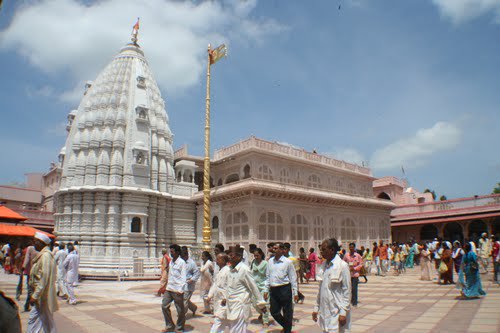
English translation of Adhyay 13. See the Glossary for special terms.
॥ Shri Ganeshay Namah ॥
1. O Creator, Supreme Lord — hurry to (us); you alone protect us.
2. You alone create the universe; who shall stop the act? Whatever (is) in your mind — that alone (comes) into creation.
3. Living and non-living, gods and demons; whatever feelings (are) formless — you give them form; everything depends on you.
4. You give importance to past accumulation. As (it is) in one's lot, so it becomes in conduct. Don't blame you for nothing.
5. As is one's deed, so is one's portion. Gana-Maharaj knows in his heart; you alone move the pen.
6. O Brahmadev, the cause of creation, creator of Saraswati — you alone seem the true support; help in the writing of the book.
7. I know the leelas, although her inspiration; (there is) no creation without you; how shall I forget at this moment?
8. One who forgets this principle does his own destruction. (One should) not be so foolish — (one should) keep (you as) support.
9. O Brahmadev who knows this — how much shall I entreat you, that the heart's desires be fulfilled, that (you) be helpful?
10. Without hearing there is no writing; this I know in my heart. Cause such a sound to be heard that shall come forth in the writing.
11. You alone produced sound; Gana-Maharaj recognized it; thereby called you, to please the devotees.
12. Accept the invitation. The formless words — give them form; they shall prove a support to the book.
13. You alone taught us: joy in the mind comes from obtaining the Guru. You produced joy; you gave it to us.
14. By worship of one, all is obtained. Why else are temples built? Whose life is ideal — only his memorial is built.
15. Those who are grateful are not ungrateful. The Shegaonis were so. How shall they leave Maharaj?
16. They shall catch his every word; cherish him at every step; consider that itself the welfare; make life harmonious.
17. One acre of land was obtained; the Master's word proved true. Beginning was made for further work; the executive committee's meeting was held.
18. One who shall do work shall not sit still; he shall ever be enterprising; from one (he shall) become many.
19. Whatever is to be created needs material and means; (it does) not (come) into form from formlessness without that.
20. The Master's devotees were there; building the math was decided; they were gathering means; were striving for it.
21. In creation everything appears thus: through one, inspiration comes; it impels another. The wheel of creation runs thus.
22. Whose order? It was Maharaj's. It would prove ideal. Why shall it not?
23. The devotees' efforts continued; people of various kinds met; various questions of various kinds, pointlessly without reason.
24. It does not happen by blabbering; it happens by action, by giving something, by expressing feeling.
25. The joy obtained — that very (joy) is obtained by giving (it). It is convinced by experience. Each one should have the experience.
26. What must be given according to the time — that alone proves proper. By giving food to the thirsty, thirst is never quenched.
27. Water itself must be given; food must be given to the hungry; knowledge needed for the ignorant; wealth needed for the poor.
28. Oil useful for the lamp; medicines and treatment for the sick; for writing impressively, lime and bricks for construction.
29. Nothing shall happen alone; what shall one alone do? Help of another is needed; mutual feeling is needed.
30. Subscription-collection began; theist-atheist clash happened; the devotees' test happened; on passing, subscription was obtained.
31. The atheists refused; they questioned the devotees: "If the Guru does yogic-leela, why have you come out for subscription?"
32. One who has nothing to do — his speech is just so. One who has something to do — it gets done by him.
33. The Creator's rule shall not break. He shall give with one hand, take in another form. Nobody shall stop him.
34. The principle was understood by the devotees; (they) said to the atheists: "Know wealth (as belonging) to the body; know devotion (as belonging) to the soul.
35. One who practices the principle crosses the worldly ocean. Birth and death (are) of the body; never of the soul.
36. Death is certain for wealth; no death for devotion. Know the eternal; take it close."
37. The Master's devotees shall speak; they shall speak from the heart; they shall speak fittingly; they shall be effective.
38. Allure (others) by the influence of speech, by virtuous disposition, by good qualities, selflessly, with benevolent disposition.
39. Such karma as occurs (so) — that alone proves effective. Maharaj's devotees were clever; therefore they spoke so.
40. "This math is not ours; this math is yours alone. What is ours in the world? Everything is yours."
41. "Mine" and "yours" — they understood the difference; brought that into action; the work-purpose was achieved.
42. Saying "mine, mine" — no meaning attaches to it. Saying "yours, yours" — the true meaning is in living.
43. The atheists' ignorance fled away; influenced by the devotees, they became wise from it.
44. They became ready to give subscription; theist and atheist became one; the feeling of unity awakened; an enthusiastic atmosphere was seen.
45. In unity all was obtained; the principle came to experience; the math's work began; work was divided according to capability.
46. "This is not only the devotees'; it is our duty too. This math is everyone's; not mine alone."
47. There was no "I" in them by birth; that feeling was in their action. For the math of Sat-Chit-Anand, the Master had to do work.
48. He knew in his heart; could not sit still; (one) must do (it) thoroughly — this he knew.
49. He spontaneously got up; sat in the sand-cart; began to drive the cart; took the cart toward the math.
50. Some people's work was construction; some people's was supervision. Importance is the same for both. The Master's was supervision.
51. The rest's was construction. This too is fixed; it happens according to time and time. Before the Creator nothing prevails.
52. He sat at the construction site such that he wouldn't get up at all from there. The devotees asked him; (he) put all into a quandary.
53. The land is only one acre; discussion went on among devotees; the Master's command — accordingly the work of construction.
54. The Master is the central place; taking that as the standard, doing the construction, the surroundings shall be fine.
55. Measurement of the place was done; eleven gunthas fell short; entreaty was made to the official; oral discussion took place.
56. The official melted; gave one more acre; gave oral consent. That itself proved harmful.
57. The oral has no value; paper documents have value; many times this comes to experience; so it happened here.
58. Mischief-makers filed an application; alleged eleven gunthas; (claimed they had) deceived the government, usurped the place.
59. The devotee-fellowship in thought; informed the Master; in the adverse situation, asked (him) to save (them).
60. The Master knew everything; said to his devotees: "There shall be no fine on you; let your minds be free of worry."
61. Joshi the official inspected the place. Inspiration was given by the Master; something different came to happen.
62. Joshi made a remark: "Whatever fine (is) on the institution, may it be excused; the institution is not the cause of the fine."
63. The fine amount was returned; such was the order; all the devotees were content; the Master proved true.
64. Getting back the amount from the government — that work was not so easy; the Master's grace was firm; thereby the work was done easily.
65. The Master's power was understood; (they) prostrated at the feet; the news spread everywhere; astonishment came to all.
66. Devotees from afar began to come; began to make various vows; (they) felt the vows would be fulfilled; thereby vows were made.
67. One who is troubled by the sun, who finds heat unbearable — only he takes the support of shade; (it has) no value to others.
68. The Creator created both; nothing remains without use; without necessity, not useful at the moment.
69. According to time one takes shelter; achieves one's purpose; sometimes asks for the warmth of love; sometimes seeks the spring of compassion.
70. When someone becomes diseased, he takes treatment for becoming free; medical treatment proves useless; (he) hurries to the Master.
71. Gangabharati of Savad — destined experiences came across; many illnesses to him; chiefly leprosy.
72. "Let beautiful and good come to me" — so each one feels. The husband wants a beautiful wife; the wife wants a healthy husband.
73. Each insults the ugly; never shelter for the ugly; place is for the fair; (people) push away the dark.
74. If (it is) called a body, illness shall come; (it shall) not stay as it is; sometimes mild illness, from which sometimes severe shall come.
75. Some torment lifelong, are not cured by medicine, but medicine has to be done — (they) endure as long as the body (does).
76. Gangabharati had leprosy — not ordinary, but leprosy. Cracks come on hand and foot; the body becomes broken.
77. Each limb becomes weak; (it) is known as contagious; nobody shall come near; life becomes unwanted.
78. By past accumulation, illness happened. To avoid the torment, took the shade of the wish-fulfilling tree, took the road to Shegaon.
79. Gangabharati had a powerful voice; (he was) superior in singing. But it pleased no one; (he) was rejected at every moment.
80. Great longing for darshan; the Master alone seemed (his) support. But the disciple-circle — how shall they let (him) come close?
81. He raised the resounding of bhajan; eyes were running (to look); he became impatient to hear the tone of the experience-having-ended.
82. At last a good day came; the destined experience ended; he fell into the Master's sight; fell at his feet.
83. The Master slapped him on the face; coughed in a moment; threw phlegm at him — this was the medicine for leprosy.
84. Some people saw; it seemed strange; it seemed disgusting; was not borne by others.
85. In the world the eye has great importance; as the eye sees, so it comes to mind; action depends on that.
86. Equal importance to faith, to the simple feeling within. Thereby no doubt to the mind; never shall it come to him.
87. Although all see one (and the same), the eye sees differently; as one sees, so it appears to him.
88. Wealth, power, and woman — as you see them with the eye, so they manifest. Don't blame them in vain.
89. Where the Master bathes — applying that earth on the body, considering it medicine, Gangabharati lived life.
90. A sadhu there — it was not pleasing to his mind. He spoke to Gangabharati: "Don't apply earth on (your) body.
91. How foolish you are! You smear earth on body; consider (it) authoritative as medicine, but not useful for disease."
92. The sadhu hectored Ganga: "Don't do such tricks." The sadhu didn't even understand simply that the world is created from what.
93. A wish in the sadhu's mind, to test the faith: "Let us take of that earth; let us take of its smell."
94. On taking earth from that place, the sadhu's proved foul-smelling; Ganga's proved fragrant; the greatness of faith was understood.
95. Thus fifteen days passed; he applied earth on the body; the disease began to fade; difference came in the body.
96. Then came to meet (him) Santoshbharati, his good son, and likewise his wife along, to inquire (after his) condition.
97. Both began to entreat him to take (him) to (their) home: "The illness has subsided; let us go now to return."
98. Gangabharati understood the essence: in reveling in saint's company is the essence. The wise one shall go forward; shall never turn back.
99. Gangabharati refused: "You go to your home. I, alone here, am well; I shall stay at Shegaon now."
100. Gangabharati did not go; did not leave the shade of grace; recognized attachment-illusion; did not fall in their net.
101. Maharaj had many devotees; (they) told the Master their hearts; would take him to (their) homes; would achieve their motives.
102. Such was Zhyamsing of Mundgaon by name, a devotee of Maharaj — motive (was) to take (him) home.
103. The Master accepted; went to Mundgaon; many devotees gathered; began to perform worship rituals.
104. Pure motive of worship, of holding bhandara, of doing the Master's service, of finding joy in it.
105. Should be a good day for a good convergence — (this) Zhyamsing did not know. He decided on bhandara on rikta tithi (chaturdashi).
106. This did not please the Master. He said to Zhyamsing: "Don't (have) bhandara on rikta tithi; do bhandara on poornima."
107. The next situation was known; but Zhyamsing did not understand; completed his own stubbornness; at the (last) moment, confusion came.
108. Rain caused a mess; pouring rain came down; bhandara remained half-done; Zhyamsing was bewildered.
109. He held the Master's feet; entreated the Master; the Master stopped the rain; the rain listened to him.
110. On the tithi the Master told — that is, on poornima — bhandara reached completion; (they) understood the Master's authority.
111. To stop the rain for a devotee — what gracious gaze of the Guru! Gurus contemplate devotees' welfare; awaken (them) from time to time.
112. Bhandara on poornima — really completed; great joy to Zhyamsing; (his) face filled with joy.
113. At Mundgaon, Maharaj had many devotees of his. Among those, one devotee was named Pundalik.
114. Pundalik, son of Ukirda, was an only son. The crop of excellent impressions; each action displayed (it).
115. In the krishna-paksha (dark fortnight) of every month, (he would) go to the Guru-temple. In fulfilling a resolve, many obstacles come.
116. Steadfastness comes to use, in fulfilling the motive, in ignoring calamities; the motive is achieved.
117. The plague epidemic came; began to surround each one; took Pundalik close; great calamity came.
118. One who finds a way out of calamity, who reaches the aim of his goal, who is not perturbed — proves an ideal indeed.
119. Pundalik proves to be in that; he was in firm resolve, in doing the foot-pilgrimage, in going to Shegaon.
120. The fever in his body would not go; the weakness would not go; (he) could not stay without doing the pilgrimage; the pull in (his) consciousness could not be stopped.
121. Mother and father reasoned with him: "We shall arrange a horse-cart; by that we shall go to Shegaon, for the Guru's darshan."
122. By the strong willpower, by firm singleness of purpose, Pundalik who lived by the resolve, shook his head in refusal.
123. "I shall do the pilgrimage on foot; shall go to Shegaon thus. If death comes on the way, place me on the Guru's feet."
124. Mother and father fell into worry; could not break the son's stubbornness; all set out on foot; began to entreat in their hearts.
125. The body just kept moving; the lump under the armpit began to hurt; began to ask for it to be made tender; began to seek the Guru's grace.
126. Each step was falling forward; leaving the test of essence behind; who wins in it — that, as it were, (he) was watching.
127. On the strength of Guru-faith, on a strong resolve, was covering the distance, as if (his) aim (were) on goal-fulfillment.
128. Nothing endures in the world; the seen-witnessed states (are) so; do not escape the rule; only the goal retains importance.
129. Calamity comes and goes; the importance of averting it endures; in facing it, the goal is reached.
130. This very teaching for Pundalik — it itself came to use. The three came to the math; they held the Guru's feet.
131. The Master knew everything; pressed his own armpit; made the lump on Pundalik tender; his illness fled away.
132. Sticking to illness — never (one) likes; (one) makes the suffering aware (of him), to do treatment on him.
133. For a reason illness comes; in time it flees away. (It is) the relationship of convergence and right-convergence — which comes together by Guru's grace.
134. Gurus consider in joining; never in breaking. They always join devotees; make even enemies friends.
135. Guru's grace upon Pundalik, to remove the plague-lump. May such Guru-grace be obtained by devotees, to remove calamity.
136. In fulfilling the devotees' motives, the Master had to be engaged. This story comes in the next chapter; you shall be absorbed in reading.
॥ Shubham Bhavatu ॥
॥ Offered to Shri Ganapati and Saraswati ॥
॥ Thus ends the thirteenth chapter of Shri Guru Gajanan Leela Granth ॥