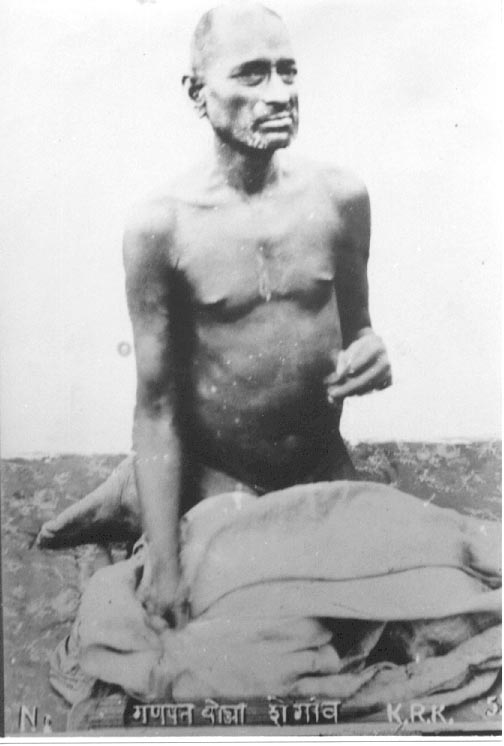
English translation of Adhyay 16. See the Glossary for special terms.
॥ Shri Ganeshay Namah ॥
1. O Supreme Lord, remover of disease and trouble — help (this) child; hurry to (us).
2. You remove disease and trouble; Gana-Maharaj knows; (I) keep the burden on you; entreat you again and again.
3. Don't (let me) keep contemplating troubles; thereby no peace in heart. Let the mind be caught in name-remembrance, in heart obtaining peace.
4. In name-remembrance all is obtained; eternal and impermanent are known; love settles on the eternal; the eternal is obtained.
5. Don't, don't (have) that trouble; don't, don't (have) that disease. Who shall accept disease and trouble? They are not so simple.
6. What I want — should be known; help in every way; let the writing of the book be easy; let the mind be caught nowhere.
7. In getting caught is the entanglement; by no means does it untangle; in detachment, entanglement does not afflict; the detached one alone proves the savior.
8. Listen to my entreaty; let (your) gracious gaze be obtained; cause such an act to be done as may dwell in others' hearts.
9. In gracious gaze all is obtained; in self-praise all is lost. Those who know this principle — they alone keep faith on you.
10. Don't catch me in self-praise; let consciousness remain in the writing of the book. With distracted mind, what shall come down in the writing?
11. In faithfulness all is obtained; by relying on faithfulness, its importance is known; this principle is known to (only) a few.
12. One who knows the importance of faithfulness shall not listen to another; he shall listen only to one — that is, the inner soul.
13. So it was with Pundalik Bhokare; he did not listen to anyone else; he listened to the inner soul, indeed to the inner voice.
14. Pundalik of Mundgaon, one devotee of Maharaj. The Thakreen of the village said many (things), made many efforts at deflection.
15. She allured (his) consciousness in many ways, gave him various allurements: "By any means, Pundalik should listen to ours."
16. Thakreen said to him: "Tomorrow let us go to Anjangaon, to make Kashinath, the disciple of Kejaji, our Guru.
17. If many questions are asked, we shall be satisfied. Don't make Gajanan the Guru. What knowledge does he have?
18. Don't (have) the naked-mad mystic; fall at Kashinath's feet; he is the proper one to make Guru; let us go to take his instruction."
19. This did not please Pundalik; he said to the Thakreen: "Don't bring the Guru into comparison; I shall make Gajanan my Guru.
20. In comparison there is decline; in comparison there is exile; by faithfulness, good company forms; thereby a tasty meal."
21. The Thakreen went to her home; Pundalik went to sleep at night. The result of faithfulness — Guru Gajanan came in the dream.
22. (He) said to Pundalik: "Don't go to Anjangaon." Began to whisper in his ear: "Don't forget 'Gan Gan Ganat Bote.'
23. Why uneasiness in the heart? What pull in your consciousness? In what thought are you so much? Welfare itself shall be in speaking."
24. Pundalik asked for padukas: "I shall worship (them) by daily observance. The pull of the padukas — that has driven me mad."
25. The Master recognized Pundalik — what motive in his mind. (It) seemed proper to Gajanan; thereby (he) gave the padukas to Pundalik.
26. Joy came to Pundalik; (he was) awakened. (His) eyes did not believe; (he) said: "Is it real or a dream?"
27. The day dawned. The Thakreen came home. Said: "Let us go to Anjangaon to make Kashinath the Guru."
28. Pundalik refused; declared firm resolve: "(I) shall make Gajanan the Guru, by which I have been given the padukas."
29. The dream appeared before the eyes; the mind was caught in the dream itself; the mind was caught in Gajanan; was caught in his padukas.
30. Each moment seemed extraordinary; the moment came to verify the dream true or false; the situation came to test Guru-faithfulness; confusion welled up in (his) mind.
31. "Maharaj, you have deceived (me)? With the dream I am confused in mind. I really took the dream (as true). Let no one (have) such a situation.
32. I placed faithfulness on you; sent away the Thakreen now. Letting go what (was) in hand, (I) am running; nothing has come to hand now.
33. I am not of this side or that; (I) have not become anyone's. The padukas in the dream — I had longing for them.
34. The dream gave a deception; the padukas have not been obtained. To this unfortunate Pundalik, fortune has given a betrayal.
35. What worship shall I do? What shall I gain in (my) lap? I shall remain unfortunate; Guru-attainment shall not happen for me.
36. What shall I take as true? The dream or the reality? On what shall I keep faith? On the actual or on the dream?
37. Don't, don't (have) those mind's plays; harmony shall not sit in them. Who knows the Creator's time? All his plays go on."
38. Pundalik fell into thought; became uneasy in mind. The merit-moment was rising; Pundalik did not know.
39. The second watch was ending. Quite at noon time, Zhyamsing came to Pundalik's house with great curiosity.
40. Zhyamsing was very clever; he made Pundalik speak; heard the news of the dream; learned the power of faithfulness.
41. Pundalik said to Zhyamsing: "You had gone to Shegaon. What command came from the Guru? Did he not tell me anything?
42. Why did he not send padukas for me, which I had seen in the dream? I kept faith on them; thereby (I) made Gajanan the Guru."
43. Padukas (were) placed in the bag. Zhyamsing gave (them); tears of joy came to Pundalik's eyes.
44. Goose bumps stood on the body; verified true and false; the mind's illusion was removed; the glory of Guru-faithfulness was convinced.
45. Zhyamsing said to Pundalik: "Two days ago when going to Shegaon, (the Master) gave the padukas; said: 'Give to Pundalik.'"
46. Pundalik took the padukas; offered flowers of devotion and faith; began to dance with joy; said: "Now let the Thakreen come."
47. The Thakreen learned the news; she recognized Pundalik; her mind ate at her; the fruit of faithfulness was understood.
48. Such high-grade devotion; the dream's account proved true. With the inner-being's pull — there itself (the dream) comes to demonstration.
49. Gana-Maharaj tells all: don't forget Pundalik, his Guru-faithfulness, the inner being's pull.
50. Without true earnestness, without true longing, without persistence-efforts, nothing comes together.
51. As Pundalik of Mundgaon, so the Master had many devotees. Bhau Kavar was among them, who proved a symbol of faithfulness.
52. Rajaram Kavar of Akola, business was money-lending; was of religious disposition; the household ran in harmony.
53. Two sons to Rajaram. (They) called the elder Gopal; the younger's name was Trambak, but his everyday name was Bhau.
54. Rajaram was a supreme devotee, single-minded toward Gajanan. From time to time at Shegaon, the mind became content with darshan.
55. His younger son, that Bhau Kavar, had to go to Hyderabad to study medicine.
56. When coming to Akola during vacation, peace would not come to him. (He) felt: let me go once to Shegaon for the Master's darshan.
57. Once when at Akola, the pull of darshan came to consciousness. "Let us take pithale-bhakri as prasad" — but whom to tell now?
58. The mother died in childhood; who shall fulfill the wish? Considering telling the brother's wife, (he) was afraid of the brother's wife.
59. The pull of Guru-meeting in mind; no peace in mind; how to speak did not come to him; no way out was seen.
60. A short while passed; (he) became eager to tell; began to ask permission; told the motive of Guru-meeting.
61. The brother's wife said to him: "Just that? I shall make pithale-bhakri; take (it) to Shegaon; feed (it) to the Guru."
62. Bhau Kavar was happy; understood the brother's wife's mind; saw the feeling of motherly affection; said: "I was afraid of her for nothing."
63. The brother's wife cooked; the pithale-bhakri plan was made. Bhau said to her: "Because of you (this) going to Shegaon."
64. Three bhakris smeared with butter, three onions, a handful of chilies, pithale along — the master set out taking all.
65. Hurriedly came to the station; on looking at the watch, the train was not seen at the station; said: "Late in coming."
66. Became dejected in mind; sat in a tone of disappointment, in waiting for the next train — fully three hours of that.
67. In the mind made the call to the Guru: "Late in coming; forgive me; but prasad to you first."
68. Bhau sat waiting at the station; sat without eating. Here at Shegaon a different affair: the Master refused the meal.
69. The Master would not take meal; would not take anyone's prasad. All devotees were trying to turn his mind, but the Master would not say anything.
70. (He) would not tell the motive of (his) mind; success would not come in their efforts; many entreaties were made; (it was) hard to entreat.
71. The Guru would not eat; thereby no one would eat; many questions were asked, but no success came in it.
72. Maharaj was absorbed in mantra-japa, in the contemplation of one devotee; (he) did not revel in five-fold delicacies, but was in the morsel of bhakri.
73. Here Bhau sat in the train; the thought of Shegaon went on; originally late, confused by mental state.
74. Caught in the cycle of hope and disappointment; with the longing of Guru-meeting; eager for the meeting; no other thought in mind.
75. The people in the compartment were watching; experiencing something different. Tears were in his eyes; was waiting for Guru-meeting.
76. Bhau could not speak; was absorbed in the Guru's trance; by signs (he) made all (keep) away; was absorbed in Shegaon itself.
77. Bhau saw nothing without the Guru. Who recognizes (this) within the mind? Such a rare devotee — who, who does not live without the Guru?
78. Each station was passing; the next thoughts were coming; were increasing the longing; were taking (him) into different thoughts.
79. So impatient in Guru-meeting — how shall patience remain to him? He who has become firm in the Guru — how shall he stay still in the train?
80. In the train was in body, but at Shegaon was in mind. None knew him; thereby (they) asked many questions.
81. Watching, watching, Shegaon came; (he) felt: "When shall I get down?" The train coming into the station ran slow; without it stopping (he) could not get down.
82. As the calf takes the road to the cowshed, so Bhau's state appeared; the figure became eloquent through action; such pull in his heart.
83. The foot did not have to step forward; the body was leaping with mental speed. What had happened to Bhau — was not understood by the watcher.
84. Running, running, came to the math; came to see Maharaj. The whole family appeared dejected; became confused in mind.
85. Nobody would say anything; nothing was understood by him; (he) felt that Maharaj would not meet at all; many doubts in mind.
86. Began to roam here and there; the longing came to its end; the Guru sitting was seen by him; took a breath of relief.
87. Maharaj said to Bhau: "Hey, how long you kept (me) waiting! I had to remain hungry; thereby no one ate.
88. Take out the butter-smeared bhakris, handful of chilies, onions and pithale together — take out the whole provision."
89. The devotees looked at Bhau; were freed from one situation; placed the prasad before the Master; Bhau pleaded with the Master.
90. No use of speaking with Bhau; whatever was being understood in (his) mind. The Guru's wish could not be broken; such is the Guru-disciple relationship.
91. Each waits for the other; blessed is that Guru-devotion; an ideal in life — that should be impressed in our heart.
92. Practice such devotion that the Guru waits for the devotee; takes the devotee's provision into his lap; in that consider the body blessed.
93. Earnestness needed in the inner being, by which Guru Gajanan takes (one) close; let the prasad not be enchanting — impress this deep.
94. If called the mind, contemplation shall happen; (it) shall never remain empty. If called the body, illness shall come; (it) shall let no one go.
95. As long as illness comes, that long it goes; according to the disease, trouble arises; thereby the soul becomes troubled.
96. So is worry — by contemplating worry, the worry becomes more intense; thereby no peace comes to the soul.
97. Don't contemplate worry; don't burn the soul; do remembrance of the Name; thereby removal of worldly fear and worry.
98. The Name itself removes worry; thereby harmonious life. Don't live without the Name. Tukaram knew the principle.
99. Tukaram, a farmer of Shegoka, had great love for the Master; would come for darshan from time to time; (his) soul reveled greatly in it.
100. (He would) come for darshan, fill the chillum, sit near the Master, watch what was needed and not.
101. This was his daily practice; never was there a break in it. But farming-business would not be left; spiritual life along with worldly life.
102. One day dawned. The situation proved the pretext: a hare ran in the field; one hunter kept searching.
103. The hare would not be obtained; the hunter would not let it go; without making the hunt, peace would not come to him.
104. The hare was seen running; the hunter aimed the gun. The bullet did not strike the hare, but Tukya's ear.
105. Tukya was bloodied; medical treatment began; time passed, but no relief came.
106. The headache would not stop; no work occurred to him. Many people met (him); gave advice to do (this and that).
107. Remedies proved unavailing; the disease did not get better; the headache continued; nothing came to mind to do.
108. If called a beginning, the end shall come; nobody shall prove an exception; the time too is fixed; only one knows it.
109. Tukya had to take many people's advice. One person suggested to Tukya: "Why did you not ask the Master?
110. You should stay in Guru-service; sweep and clean in the math; remove the bullet; avert the disease and trouble."
111. Tukya was convinced; began the sweeping of the math; practiced service from the heart; saw the test of his essence.
112. Year after year passed; Tukya's service continued; he did sweeping with faith; finally faith bore fruit.
113. Fourteen years he swept the math; never did weariness come to him; kept faith on service; was freed from exile.
114. Sweeping, sweeping the math, one day dawned. The bullet fell while sweeping; took the disease with it on going.
115. Tukaram got relief; such (was) the result of Guru-service. He whose resolve is firm — for him the Guru himself is Ram.
116. Gana-Maharaj tells the devotees: by the Name (one) should be awake; with the company of the Name with faith, life should be lived in good company.
117. As Guru-faithfulness bore fruit for Pundalik, Guru-devotion-longing for Bhau Kavar, Guru-service for Tukaram — so may it bear fruit for all devotees.
118. Gana-Maharaj tells all the devotees: never forget the Name; the Name alone shall take (you) to the further shore. There itself the sixteenth chapter reaches completion.
॥ Shubham Bhavatu ॥
॥ Offered to Shri Ganapati and Saraswati ॥
॥ Thus ends the sixteenth chapter of Shri Guru Gajanan Leela Granth ॥