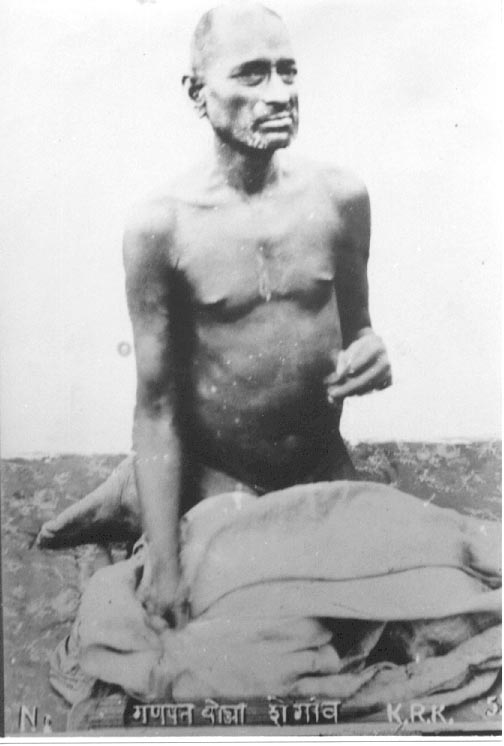
English translation of Adhyay 7. See the Glossary for special terms.
॥ Shri Ganeshay Namah ॥
1. O Ganesha, elephant-faced one — you alone remove sorrow; you keep your devotees in happiness.
2. You are lord of the ganas; lord of gods and goddesses. On obtaining your gracious blessing, the blessings of all gods and goddesses are obtained.
3. You are the leader of all; who shall forget you? He who forgets you — his strength is scattered.
4. He who keeps you near — you remove his obstacles; you cast a gracious gaze on him; you help in every way.
5. Not without reason are you called Vighnaharta! Sukhakarta! O Compassionate One! You sanctify your devotee, when devotion is performed with humble feeling.
6. Even by a mere gracious gaze, devotees benefit so many times! How much benefit in your company! Let there be your company always.
7. Who shall solve your mathematics? You are the father of learning. Your knowledge is fundamentally vast. Who shall make a wager with you?
8. You have not had less torment — as one can imagine from your face. Though you bear torment, you keep all happy.
9. Not without reason are you called the giver of happiness, O Ashtavinayaka! O Siddhivinayaka! Hear Gana-Maharaj's prayer.
10. Help for the devotees; let there be gracious blessing; let the writing of the book be without obstacle; let the devotees always be content.
11. As Ganapati is leader among gods, so was Khandu Patil at Shegaon. He was skilled in handling the village's affairs.
12. The Patils were religiously cultured by nature; they used to celebrate the Maruti festival. In addition, the grace of (saint) Gomaji was great upon this Patil family.
13. Gomaji's field of action was Nagjhari, where the Ganga-Godavari ripples were created. Blessed is that Nagjhari, where saints reside.
14. The home upon which a saint's grace falls — that household becomes joyful. Saints alone immerse one in devotion; through devotion alone is joy obtained.
15. Mahadji, the original ancestor of the Patil family, never said "yes-yes" to anyone. He said "yes-yes" only to one — by which always (he kept) his (Guru's) favor.
16. He said "yes-yes" to the Guru; he kept awareness of his grace; thereby the company of the path of devotion; thereby the company of good fellowship.
17. Such impressions were formed on generations; generations and generations were ready to keep them. The Patils repeatedly showed great importance to good impressions.
18. Form such impressions on offspring that others may obtain joy thereby; let the heart obtain peace and contentment; make the body's existence meaningful.
19. The soul has to be reveled somewhere; otherwise weariness comes. By reveling in a good place, enthusiasm comes; the soul obtains joy.
20. Good and bad need not be taught; we know unconsciously. By neglecting the inner voice, one must bear torments.
21. Don't have torments for the soul; don't, don't have pain for it. Know the inner mind; bring it into practice.
22. What is very simple becomes difficult by neglecting it; the mind gets allured elsewhere.
23. By whom should one be allured? By divine sovereignty. Don't be allured by mirage; thereby is one's own destruction.
24. Don't misuse strength; don't give pain to others; don't give anguish to the soul; don't wound another's soul.
25. In life, the soul has great importance — this is what the Vedic essence tells. Don't have mere burden on the body; place the burden on good qualities.
26. The Patil family was a symbol of strength; each one was a wrestler. The Patil family was a symbol of devotion; religious feeling awakened in each.
27. Two brothers, Kukaji and Kadtaji — the village looked to their call. Both watched out for the village's good; not for themselves alone.
28. Each one's fortune was different. Kukaji had no children; Kadtaji had six sons. The whole household ran in joy.
29. Khandu Patil was called the chief; five brothers as his companions — Narayan, Hari, Ganpati, Krishnaji and Maruti.
30. Blessed is that Patil lineage that obtained the Guru's gracious gaze. All the wonder is of past merit, and added to that the new accumulation.
31. Without the Guru, nothing exists; in casting (the Guru) aside, anguish remains. Where the Guru's grace remains, the kingdom of joy remains.
32. The Master's stay was in the temple, in Maruti-raya's proximity. Disciple Bhaskar was in service, under Maharaj's umbrella of grace.
33. Where Maruti is, there Ramraya is. He who forgets himself — he alone gives to others.
34. In the establishment of one is the establishment of the other. The conception is given form by devotion alone; mind's restlessness becomes idle prattle.
35. By action alone all is obtained — this truth comes to experience. The soul has to do karma; without karma there is no living.
36. What is true, how shall it become false? Those who uplift the world — their festivals are held.
37. The purpose of holding a festival is unity, place for joy; no place for hostile feeling; rather peace of mind and contentment.
38. The Patils were rough by nature; they did not know the Master's mind. They would speak harsh words to him; they would give various torments.
39. Various torments to the Master — Bhaskar could not bear it. He said to the Master: "Let us go to another place."
40. Maharaj said to Bhaskar: "Pain comes upon this body. We are not aware of it; thereby no anguish to us.
41. He who forgets the 'I' — what pain shall come to him? Pleasure and sorrow appear the same; he bears destiny joyfully.
42. Bhaskar! Know the principle a little. All this is the spread of the Lord. Even disease and trouble find shelter; no poor wretch is free.
43. As is one's accumulation, so is one's share in the spiritual. The Patils were entirely in the Guru's service; thereby village authority was in their hands.
44. Attention on the village's people. Sadhus or pretenders should not cast eye on women. When complaints reached their ears, they would punish severely.
45. The Patils were village leaders; they had great authority over the village. Pure motive in their inner being; they preserved the honor of women.
46. The Master knew this — the hidden motive in the Patils' minds. There was no blind faith in their mind; they always investigated by verifying.
47. The Master said: "Hey Bhaskar! Don't be hasty; have patience. Keep faith in me. The Patils alone shall run the affairs."
48. The Master recognized this; the Patils ran the affairs; generations and generations toiled; they revelled in service.
49. To know truth, one needs a person of right kind. He who has a pure heart — to him truth becomes known.
50. Khandu Patil, very clever, began to keep a sharp eye; he began to record Maharaj's movements; he was not weary of testing.
51. The Patils would test; the Master would undergo testing. None can avoid karmic experiences; the world's procession runs thus.
52. The world becomes wise through situations, all through coincidences. From each situation a teaching — this is the Master's mastery.
53. Nothing of the right convergence is deliberate; all is spontaneous. The examiner and the one being examined should both be of worthy quality; thereby the value of the test is preserved.
54. Hari Patil was a wrestler — Khandu Patil's brother, mind you. Roughness by nature; along with that, Patil-ship.
55. One day Patil Hari began to provoke Maharaj greatly. Maharaj ignored him; great endurance in his being.
56. Hari incited him: "Throw me down in wrestling; defeat me, otherwise you shall be embarrassed."
57. The Master said to Hari: "Don't get into trouble. You wrestlers are strong, but not in yogic strength.
58. Don't make a wager with me. Make a wager with a wrestler. He must be of equal level; otherwise calamity from the situation."
59. Hari did not know worth; he began to consider the Master inferior. Pride was the cause; he was content in his heart.
60. Pride does not endure in the world; pride alone does the destruction; none crosses over with it; this comes to experience.
61. Hari did not let go of stubbornness; he did not recognize pride; he did not recognize the Master; he did not desist from the wrestling match.
62. Preparation for wrestling was made; spectators gathered at the wrestling ground. Today's wrestling reached its peak — never had such been seen before.
63. The wrestling came to its peak; Hari's body was bathed in sweat. The Master did not move at all; Hari's strength fell short.
64. Gajanan sat down. He said: "Lift me up now. Even if you are a wrestler, I shall not move from here."
65. Hari made many efforts; the Master did not move at all. He tried all moves; all efforts proved in vain.
66. Hari thought: "How shall I throw him down?" The same discussion among spectators: "Such a wrestler we have not seen.
67. This is no wrestler; he has yogic strength in his body. Hari, without knowing the means, will become the cause of disgrace."
68. A wager was made among spectators: "Who wins today?" Each was eager today; the match was on today.
69. Hari lost the wager; the Master won the wager. Hari knew today: he had met one of equal level today.
70. All spectators became silent; the yogic power was understood by all. Hari's face fell; the Master said nothing.
71. Hari recognized the Master; he went to surrender to him. "Teach us whatever you know."
72. Hari recognized the power; experienced it directly; gave up tormenting; resolved in his heart.
73. Hari told his brothers: "Don't go in his way. You shall be cause of disgrace. I have known the yogic strength."
74. But how shall the brothers listen? They become wise only by experience. Whose mental nature is this — they shall not stay still without experiencing.
75. One shall have an experience; another shall be in pain. The wheel of destiny shall run; who shall stop it?
76. The mark of a yogic person should be seen in his endurance. Common men test by giving pain again and again.
77. The Master never told anyone that he knew the leelas of yoga. He did not know how to display through speech.
78. The Master is not told; the Master is recognized. He proves to be Master only by action; he conveys the importance of yoga.
79. As a wife cares for her husband, so the Lord cares for the devotee. On whom love settles — there it happens thus.
80. One must seek another's favor; the other takes care of him. The devotee inquires after the Guru; the Guru removes the devotee's worries.
81. All depends on each other; nothing in the world is solitary. This is convinced by experience. Someone has to live for someone.
82. So it was with the Patils; they were striving for the village. The whole village depended on them; everything ran on their signal.
83. Hari Patil lost in wrestling; he became absorbed at the Master's feet. His brothers said to him: "Why are you afraid of this madman?
84. We are Patil's sons; our bodies are sturdy; we have the village's authority too. Why bow your head?
85. This madman is rough; from eating free has become wicked; his pretense has grown big; a thorough fraud and rogue.
86. Let us alert the people; let us stop the madman's pretense; let us beat him up so that he leaves the village.
87. Taking the garb of a sadhu, beguiling poor women, drawing them into his web, he will take them away.
88. Without testing, how shall we know? Without beating him, true and false will not be known.
89. We are Patils of the village; the rope of authority is in our hands; protecting the village is our duty."
90. The Patil brothers were very strong; they were always subject to anger; they would dominate others; they would flaunt the Patil-ship.
91. The brothers said to Hari: "Let us beat him with sugarcane bundles. Let us go to the temple; let us drive the naked one out."
92. The brothers came to the temple, with sugarcane bundles. They began to ask the naked one: "Hey naked! Will you eat sugarcane?
93. We shall strike with sugarcane; if not a single welt appears on your back, we shall give you the cane; otherwise we shall beat you."
94. Hari did not agree to any of this; Hari said nothing. But the brothers were not convinced; they could not contain their anger.
95. They said: "Don't stay in this place. Show your yogic leelas." Anger became uncontrollable; speech and fist were used.
96. They took up the sugarcane bundles; began to loosen them; took out one cane after another; began to strike on the back.
97. No one could watch this. The Patils struck with cane. Maharaj began to endure; tit-for-tat behavior did not happen.
98. The onlooker began to flee in fear. The summit of endurance was reached. Not a single welt appeared on his back. Each was astonished.
99. The Patil brothers became weary; they came to surrender to the Master; expressed remorse. The Master became summit and peak.
100. As the peak was, so was the foundation. What is in the inner being — that alone manifests.
101. The Patils' mental disposition, Maharaj's mental disposition — both had different karmas. All knew the secret of it.
102. The Master said nothing. He took the canes in hand. He squeezed them quickly and gave them to the Patils. He showed yogic power.
103. Situations were coming upon the Master; daily new ones occurred. The Master came to be (known) through personal experience. Some of those situations come here.
104. Kukaji was Khandu's uncle. When difficult situations came, he would call out to the Lord. One day he had a thoughtful idea.
105. Uncle said to Khandu: "Let us beg of the Master. Let us obtain a son-jewel; let him prove a lamp of the lineage."
106. Khandu's thoughts began. Something was felt to be missing; the mind became distressed; he opened his heart to his wife.
107. He took his wife's consent; he took the path of the Master's darshan. Many threads of thoughts were hidden in his inner being.
108. Khandu Patil was very clever; he knew how to drop a word so it would not fall flat — the work would surely be done.
109. The other should be in good mood; only then would he listen; impress thus on the mind, the work shall be complete.
110. One has to recognize the situation; one has to be sensible. The right word at the right time — there it is useful.
111. When the Master was with disciples, in good mood, the thought came to Khandu: "Let me drop a word to the Master."
112. Khandu began to make the Master cheerful, raising various subjects. The Master knew Khandu — some good thought (was on his mind).
113. Speaking, speaking, he said: "Shri Guru! One thought greatly torments me. How shall I tell you?
114. You know all. What torment there is, what is the heart's wish — when shall it be fulfilled?
115. Have grace upon me; increase the Patil lineage. The going-and-coming of this very thought troubles my mind."
116. Maharaj said: "You are so great — fields and farms, cows and stables, no shortage of joy. Why do you ask for offspring?
117. He who shall give splendor — he alone shall give offspring. I roam the village naked. What shall I give?"
118. Khandu could not think of anything; he could not let go of Maharaj. Again and again he asked: "Without your grace, nothing."
119. The thought came to mind: I have held the Master's hand; he alone gives splendor; why should I plead with another?
120. "By the Guru alone is this splendor" — this thought was convinced in his heart. Again and again he began to plead, placed his head on the feet.
121. The earnest longing of his mind reached its end today. He became choked with emotion; he embraced the Master.
122. He invoked the Master. The compassionate-hearted Master could not stay without showing grace; his pleadings bore fruit.
123. The Master said to Khandu: "Beg of Sat-Chit-Anand. He alone shall surely fulfill your heart's desire.
124. Pleading means begging. You have asked for a child; let him prove the lamp of the lineage — this is the one entreaty.
125. Will you name him Bhikya (beggar)? Will you give a meal of mango juice? You shall have a son; the heart's desire shall be fulfilled.
126. You are full of splendor; on obtaining a son-jewel, give a Brahmin-feast; please them by giving dakshina."
127. Taking Khandu near, he gave the blessing. He was choked with emotion; words would not come from his mouth.
128. Saluting once, taking the Guru's permission, he set out for home, joyful in his heart.
129. He told the elders; he told his wife. Whatever the Master had said, all became joyful.
130. After some days passed, his wife Gangabai became joyful in her heart; the blessing began to bear fruit.
131. After some days, the wife became pregnant. There was no limit to joy; the home became full of happiness.
132. When the vow was fulfilled, a son-jewel for the wife. The pleading bore fruit; the Patils were filled with joy.
133. Khandu saw the Master: "You have fulfilled the heart's desire. You alone are truly compassionate, by which the son-offspring is obtained."
134. He remembered the Master's words; resolved to fulfill the vow. The name "Bhikaji" was given; the naming ceremony was held in splendor.
135. Kukaji's joy had no limit; he gave generously in charity; the poor and great were content; he distributed wealth and grain in plenty.
136. A meal of mango juice; calling the villagers; pleased the Brahmins by giving plenty of dakshina.
137. The Master's blessings bore fruit; Khandu's fortune arose; there was no limit to joy; sprouts grew on the family vine.
138. Let the Master give such blessings; let a son-jewel be born. Let such a Guru be obtained; let life become meaningful.
139. Blessed are that mother and father, who invoke the Guru with devotional feeling. The Sadguru-Lord became pleased; he fulfilled the heart's desire.
॥ Shubham Bhavatu ॥
॥ Offered to Shri Ganapati and Saraswati ॥
॥ Thus ends the seventh chapter of Shri Guru Gajanan Leela Granth ॥