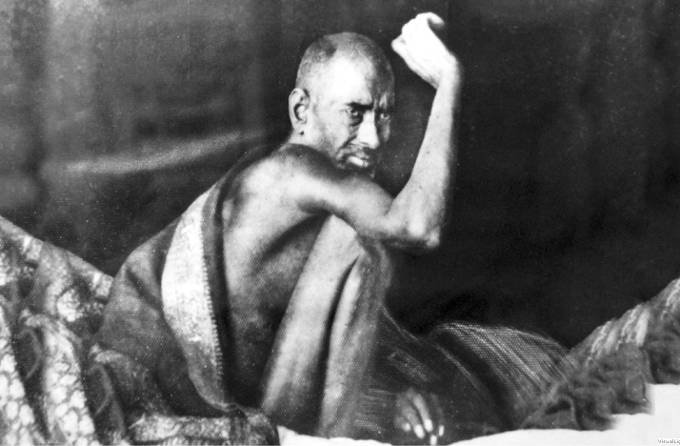
English translation of Adhyay 17. See the Glossary for special terms.
॥ Shri Ganeshay Namah ॥
1. O Savita Sun-Narayan — how much shall I entreat (you) to come to my place?
2. You destroy the darkness of ignorance; you alone have spread the spread of knowledge; ignorance gets no shelter; in entreating you, streams (of tears) from the body.
3. I make the twelve salutations; please accept them. The wife's soul too is on you; she offers a garland of devotion-faithfulness.
4. Know our heart's desires, what is the motive of (us) both: to revel in devotion (ourselves), to make others revel in devotion.
5. We are different in body, but one in thought; let rays fall on ignorance; let nothing remain to become wise.
6. O all-knowing Sun-Narayan, hurry to this place. Without your light, living is impossible.
7. Sun-Narayan! You alone protect life; you alone protect us; you alone uplift the downtrodden — Gana-Maharaj knows.
8. By your fixedness, you rise. Let there be help in the writing; your light is useful for the writing.
9. When the Guru is addressed as Sun-Narayan, by his grace ignorance is destroyed. Devotees entreat the Guru to come to their home.
10. So it felt to one devotee — Vishnusa of Malkapur: "Let Maharaj come to (our) home; let his blessing be upon all."
11. This Vishnusa was employed in Khatav's mill. When the Master came to the mill, the thought came to his mind:
12. "(They) brought Master Swami to the Akola mill, to sanctify the soil, to fulfill (their) heart's desire."
13. The horses of (one's) heart's desires are the Master. Without the Master, the chariot does not go forward; (it) gets stuck in the middle; nothing comes to hand.
14. If for the devotees' heart's desires, the horses are of the Master's grace, helpful in going forward, no one shall stop it.
15. This devotees do not forget; thereby (they) shall entreat the Master, take (him) to their home, achieve the motive.
16. In Guru's grace alone all is obtained — this is convinced by experience. Whatever convinces the mind — accordingly is done.
17. The importance of the Guru was convinced to Vishnusa of Malkapur; thereby (he) entreated the Master: "Come to (our) home."
18. The Master said to him: "Don't insist with us. Sometime later we shall come to (your) home; we know your feelings."
19. "To take the Master to Malkapur, influence (vashila) must be applied. Bhaskar is suitable for it" — the thought came to mind.
20. He coaxed Bhaskar: "You are close to Maharaj; if you say (it), it shall convince him; thereby the Master shall come (to our) home."
21. Bhaskar was convinced; entreated Maharaj: "Vishnusa's invitation has come; (let us) decide to go to Malkapur."
22. Maharaj said to Bhaskar: "Don't fall to insistence; let us go to Malkapur later; tell Vishnusa thus.
23. Don't take the invitation; (it shall) be a cause of disgrace for nothing." The Master, knowing what was to come, told Bhaskar firmly.
24. Bhaskar said to the Master: "Let us go to Vishnusa's home. Called for so much worship, shall we say no to him?
25. Bhaskar told the Master: "Malkapur is decided; I have told him so; now going has become necessary."
26. Set out to go to Malkapur — happened against (his) wish. Decided to go by train; both came to the station.
27. The train came in a moment; crowd appeared in a moment; some descending, some climbing; each in his own absorption, thoughts.
28. Entreated the Stationmaster; asked to free a compartment; entreated the Master to sit; freed (himself) of disease and trouble.
29. "Brahma-rakshasa behind the timid" — gave invitation to disease and trouble. The same situation came to experience for Bhaskar here.
30. "Let the Master sit in the freed compartment" — with this motive he said to the Master: "Baba! Sit in the compartment."
31. Maharaj said nothing; sat just so on the platform; absorbed in mantra-japa; reveling in a different kind of bliss.
32. The train would not be held longer; (it) would not run without giving the whistle; the whistle was somehow not being given; the train was not departing.
33. Bhaskar got a little confused; moved a little aside; the Master took advantage of the chance; tricked Bhaskar.
34. A thought came to the Master's mind; he followed the path; left the empty compartment; took the women's compartment.
35. A yogi protects women's honor; bad thoughts do not come to his mind; he is a protector of welfare; thereby such a thought comes to mind.
36. The women in the compartment got frightened; began to look at one another; they took the yogi as a naked-mad (one); began to drive him out.
37. Complaint was made to the police; the police had to come running; (they) explained to the Master; told (him) to get down.
38. The Stationmaster too came; learned all the news; began to explain to all: "There shall be no trouble from him.
39. Let him stay in the compartment." The women would not listen; they said: "Naked-mad in the compartment." The police too would not listen.
40. They explained much to Maharaj; no use happened. The Stationmaster made a humble prayer to the Master:
41. "Please get down. Honor the women's request. (One) must behave by the law; before the law nothing prevails."
42. Maharaj got down. On this offense of his, a case was filed against him, for behaving according to the law.
43. Bhaskar was shaken — for going against the Master's wish, for bearing an adverse situation; (he had) accepted the invitation pointlessly.
44. Bapusaheb Jathar to (do) the inquiry; (he would) give justice impartially; (he would) make complete investigation; very clever in giving justice.
45. The date of the case came; crowd gathered near the dak-bungalow; complaint was on the Master; (people) gathered to hear the hearing.
46. Venkatrao Desai had come on work; he saw the crowd; asked Jathar; learned all the news.
47. Jathar told Desai: "Call the Master." Sent a call for the Master. Someone suggested: "Make him wear a dhotar.
48. The crime of nudity has happened; let it not happen again and again. Make Maharaj wear a dhotar; only then take him."
49. When this advice was accepted, the Master was made to wear a dhotar. After going forward on the way, the Master let go of the dhotar.
50. Went naked itself for inquiry; took Bhaskar along. Jathar asked the Master: "Why do you roam naked in the streets?"
51. Maharaj smiled at that. "Take out your snuff-box," said (he). Began to rub tobacco in (his) hand. Jathar melted in a moment.
52. Jathar gave justice. Jathar said to all: "Sent the constable to call (him); but something different was experienced.
53. (He) held the constable's hand such that the blood-flow stopped; made (him) wear a dhotar; that too (he) let go on the way.
54. He was not afraid of anyone; did not take anyone's honor; did not go in anyone's way; remained in his own absorption.
55. Originally bodiless, without afflictions, he did not remain his own. Another should look after him, by which trouble shall be averted.
56. One who is with him — he alone shall take care; one who shall not look after him — he alone shall prove the offender.
57. The responsibility (is) on the one looking after him, not on him himself. He shall not prove the offender; the looker-after shall prove the offender.
58. Fire shines in the agnihotra; if it spills, the opposite — fire is not (declared) at fault; the looker-after must be vigilant.
59. Here the looker-after Bhaskar (had) to pay a fine of five rupees promptly. Bhaskar realized (his) mistake; said: "Such a mistake shall not happen again."
60. The Master had warned him beforehand: "Don't (make) the Malkapur trip; you shall be the cause of disgrace." That came to experience.
61. In disobedience of Guru's command come sorrow and torment; in obedience of Guru's command, destined experiences become bearable.
62. Whatever situations occur in the company of Maharaj — they prove instructive, prove guiding.
63. Many companies in the Master's good company; one of those at Akola. Many devotees of the Master; one of those, Bapurao of Akola.
64. Bapurao entreated the Master to come home: "Come you to Akola, to give blessings."
65. Gave assent to Bapurao; agreed to come to Akola. To go by railway — Bhaskar had no courage.
66. Bhaskar asked the Master: "To go to Akola, shall I arrange a bullock-cart, or another means?"
67. Set out for Akola by bullock-cart, to Bapurao's home. Bhaskar was afraid of the railway, of that court-paperwork.
68. Before that, Mehtabsha said to Bapurao: "Bapurao! When the mystic comes to your home, send me an invitation; I shall come to meet him."
69. Bapurao remembered; sent a man to Kurum. Mehtabsha learned through inner-knowledge; thereby set out for Akola in (his) cart.
70. He came halfway; one man met him; asked the address of Mehtabsha; said: "I have come to take him."
71. On hearing, "I myself am Mehtabsha," said (he); "Don't go to Kurum; I have learned of Bapurao's invitation; thereby (I have) set out for Akola."
72. Mehtabsha told (him); the man was convinced; sat (him) in his own cart; brought him to Bapurao's house.
73. Next day Maharaj came; saw Mehtabsha; grabbed his hair; brought him to (his) senses.
74. The companions could not bear the scene; the secret in this was not understood. (They) say to the Master: "What offense did he commit?"
75. The Master said: "Hey Mehtab! Leave the dominion here. Your prestige has spread, baba; people here are tormented, baba.
76. You should give instruction: 'Don't give pain to others.' If pain is given without cause, Allah shall not let you (off)."
77. The principle was understood by Mehtabsha. "Don't (cause) reason for spectacle." (He) said to companions: "Don't give pain to anyone.
78. I take the mystic's command as authoritative; I leave the Kurum mosque as it is; I tell another to complete (it); I obey the Master's command.
79. You should hold his feet; should obey the command." (He) sent four (people) to Kurum to complete the work of the mosque.
80. Here Bachhulal came for darshan, to give invitation. Next day a tonga (carriage) was arranged to (go) to Bachhulal's home.
81. The tonga came to Bachhulal's residence, but the Master would not get down. Many efforts were made, but no success came to anyone.
82. One clever (one) said: "Mehtabsha was excluded; thereby (he) did not get down." (They) returned to Bapurao's just so.
83. "Seat both in the tonga; Maharaj shall be pleased." (This) saying convinced all; called both to the meal.
84. Seated both in the tonga; paraded (them) in the village. Maharaj was happy; Bachhulal felt relieved.
85. Set down Mehtabsha at the temple; set down the Master at the Ram temple. The Master met Mehtabsha; expressed lofty, simple feeling.
86. The Master's teaching was visible in his actions; (he) chastised Mehtabsha, but (he) did not eat without him.
87. Both ate together. Mehtab called Sheikh Kadu; told (him) to take the ticket to Punjab; said: "(My) work here is done."
88. Sheikh Kadu said to him: "Don't leave the mosque half-done. Without you it (shall) not (reach) completion. Go to Punjab afterward."
89. Mehtab said in reply: "Who am I to complete the mosque? On (one's) own conceptions, the formless alone takes form.
90. Stones, earth, lime, bricks — these very means in both; (when) different in form, (one is) called temple, (other) mosque.
91. Don't give importance to appearance; importance should be given to what is within. Don't give importance to form; importance should be given to the soul.
92. Contemplation of the soul is the very essence; that alone shall remain immortal. Contemplation of body is ever futile; thereby it becomes a burden on the earth.
93. Forget discriminating feeling; never practice that; consider that itself harmful; live with the feeling of non-discrimination.
94. Although there are castes by birth, become one by karma, by action. Living with the feeling of unity, you shall live with happiness."
95. Sheikh Kadu understood the principle; took the ticket to Punjab; (he) understood the Master's authority.
96. Here Bapurao's wife had the trouble of bhanamati (witchcraft); marks of bibba (marking-nut) would come on the body, likewise on all clothes.
97. The garment on the line would burn; sometimes the body would become extremely hot; food and water would not taste good; the mind would not revel in anything.
98. She was weary of the trouble; she was weary of life. The household too was weary of the disease, of the trouble of bhanamati.
99. Doctors and vaidyas all came; tired of giving medicine; even called the mantrik; made amulets, threads, talismans.
100. Various kinds of remedies were done, but proved useless; spent immense wealth, but to that too came failure.
101. At last (Bapurao) said to the Master: "(My) wife has the trouble of bhanamati; thereby weary of life; many remedies (we) did.
102. Not one remedy proved useful. You must see (my) wife; free her of bhanamati. This is my prayer to you."
103. Bapurao's heart was distressed; the Master knew in a moment; (he) said: "(Your) illness shall obtain relief; don't be frightened."
104. Looked at the wife; said to her: "Daughter, what trouble? Now the disease has fled."
105. Then once the Master came to the village of Akot; friend Narsing lived there; (Master had) eagerness to meet him.
106. When (he) came to his home, after juicy chats happened, when bath came to mind, the Master went to the well.
107. Sat on the edge of the well; let down (his) feet into the well; began to peer inside; Narsing too fell into thought.
108. The uncommon ones' all (is) uncommon; thereby (it) gets primacy. This is not madness; from this comes a teaching.
109. Narsing came there; saw the scene; people gathered around; got caught in discussion.
110. (They) spoke according to their own understanding, but here something different happened. The Master seemed mad, but he himself proved Master.
111. The Master said to Narsing: "I am seeing Ganga and Godavari in the well. If they have grace, they shall bathe us.
112. You bathe daily; make your body blessed. I see their source; thereby take satisfaction."
113. The Master peered with one-pointed mind; absorbed in mantra-japa; sat right there. Astonishment came to all.
114. Steadied (his) gaze toward the well; the well filled in a moment; as if each river came; mixed in the well.
115. Even in remembrance, an invitation; making remembrance with one-pointed mind, thereby (the called one) coming on (their) own; thereby the sign shall be convinced.
116. Such calling-out should happen, that the master should be present. Invoke him so that the consciousness be enchanted.
117. The more powerful the willpower, the more powerful the action. By that progress is achieved — this is seen in the world.
118. The more powerful the willpower, the more "He" comes near. When "He" comes near, calamities take to flight.
119. One who lives in the Name forgets the "I"; one who removes the "I" — "He" calls (him).
120. Gana-Maharaj prays: O Sun-Narayan, remove ignorance; make the devotees wise.
121. Gana-Maharaj tells the devotees: know fully the One; he alone sends many. There itself the seventeenth chapter reaches completion.
॥ Shubham Bhavatu ॥
॥ Offered to Shri Ganapati and Saraswati ॥
॥ Thus ends the seventeenth chapter of Shri Guru Gajanan Leela Granth ॥