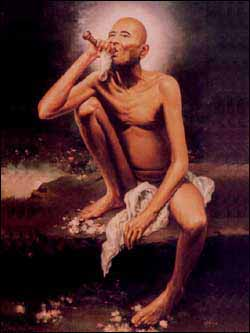
English translation of Adhyay 1. The translation preserves the verse numbering and four-line ovi structure but does not attempt to reproduce the Marathi rhyme.
॥ Shri Ganeshay Namah ॥
1. O Ganaraya, I fall at your feet. I am dull-witted by nature — how shall I write of the Guru's greatness?
2. I have no storehouse of words; therefore I retreat. Yet your image is fixed in my mind and meditation, dwelling day and night within my heart.
3. O Goddess of Speech, Saraswati, grant me good wisdom. Only by your command has the pen come into my hand.
4. Without you, what shall I write? I will be deemed ignorant. Please reside in this place — I offer you my folded lotus-hands.
5. I have offered both my hands to you; the sense of "me" and "you" has vanished. Nothing of mine remains — all has merged into you.
6. Your hands have been filled (with offerings); I am wretched by nature. I feel I must take your support — uplift me through poetic power.
7. I am a burden upon the earth, useless in worldly affairs, useless in household life. Now you alone must take me close.
8. Even in worldly esteem I am zero; without you no one else will save me. Your shower of grace alone shall make my life blessed.
9. Show grace upon me, take your seat in this place. You who accept with lotus-hands, you who call me your own.
10. How much shall I plead with you, how much shall I implore? Now settle yourself in this place, and let me begin writing the book.
11. Nothing of mine remains; you alone must write. Again and again I have entreated you and told you all that is mine.
12. Without you everything is empty, without you everything is lacking. I do not want borrowed splendor — a dependent, weak, alien life.
13. Among the old, the children, the cowherds — you are seen in all. You alone keep them in joy, by which they live in unity.
14. Whoever lives in your nearness can never be called orphaned. It is only in your company that books are created.
15. Because of you the Vedas are recited, because of you mantras are repeated, because of you the Name is remembered — how could one ever forget you?
16. Your remembrance brings inspiration and vitality; forgetting you brings desolate life. Who would like a hollow life? Without you life is dreary.
17. The soul is a fragment of the Supreme Soul; it searches for vitality. Where the soul resides, there is the company of consciousness.
18. The soul searches for you. "He" and "I" are not separate. The Lord has spread out this expanse and He alone keeps the play going.
19. One whose hands have grown weak — what book shall he write? He will run again and again to you, pleading repeatedly.
20. As you blessed the saints and Das Ganu Maharaj, may you bless all in the same way — this is the desire of my mind.
21. Das Ganu was made enraptured (by you); through the power of his books the Guru was firmly impressed (on hearts). The greatness of the Guru was so established that life seemed futile without one.
22. Sweet writing comes near the Guru; he himself sought the source. Therefore I have come near you — know all the desires of my heart.
23. I have read sweet books that invoked the Guru — by which tears in the eyes unknowingly slipped down the cheeks.
24. That Guru-Mother who fed me a morsel of the Name — may she feed each ignorant one in the same way. This is my prayer to you.
25. We are all foolish; we do not understand the mystery. You alone know the mystery — save each ignorant one.
26. By your company alone shall darshan of the Guru come; thereby their settling (in our lives), by which help comes.
27. May Shri Guru come to my house, may he settle in my house, help his devotees, and make life blessed.
28. This was the longing fixed in my mind; you knew it through your inner-knowledge. Therefore you brought me near, and my soul did not wander in vain.
29. Though I am a foolish wretch, yet I will seek out the mystery. My faith rests on you — I have placed the burden upon you.
30. I have offered my lotus-hands with my mind; you knew it through inner-knowledge. Now the writing of the book — again and again I plead.
31. You have come to this place — this is settled in my mind. What words for this gladness! Peace will come to my heart.
32. Whoever reads this book shall obtain peace of mind. When Saraswati herself writes the book, what could possibly be wanting!
33. Words will not run short; words will come of themselves. They will be words from the heart — how can they prove false?
34. O Saraswati, O Ganapati, I know your greatness. This dull-witted one prays — grant me good wisdom.
35. Gana-Maharaj invokes you, Gana-Maharaj pleads with you — let the Guru's leela be written today; let this task reach fulfillment.
36. A festival was going on in Shegaon; there was joy upon joy. To this celebration of joy, the host of devotees gathered.
37. Where the Guru manifests, there a festival of joy will arise. Joy will dwell in joy — joy upon joy will be.
38. In the festival joy is found; in it is met supreme bliss. In it the whole assembly remains forever absorbed.
39. Thereby vitality is gained, and sorrow and misery flee. Becoming absorbed in it, worry and anxiety are forgotten.
40. Whoever has the experience of bliss alone crosses the worldly ocean. Thereby everything is filled with bliss — Gana-Maharaj has the experience.
41. May everyone obtain a Guru, may everyone obtain joy. Recognize my purpose; let my heart's desire be fulfilled.
42. Saraswati and Ganapati recognized this and came to this place; the writing of the sweet book — they began it.
43. Whatever words appear in the book — they are not Gana-Maharaj's. One who completely forgets himself — what shall he write!
44. Whoever reads this book will obtain peace of mind. These words will prove true — each one will say it to another.
45. Whoever listens to this book — the fruit of merit will be in his lap. Do not roam from door to door in vain — the Guru shall come to your home.
46. He alone shall feed you the morsel of the Name, by which peace will come to the heart. An incomparable fortune will arise; worry and pain will set.
47. My Guru eats only a crust of bread, yet he is no beggar. He says: "Serve the rich dish of the Name" — and on that he is well content.
48. The Guru will eat at the house where there is faith-filled devotion. He will impress the greatness of devotion and immerse one in devotion.
49. Who is my Guru? He in whose mouth is "Gan Gan," day and night repeating the mantra — such is Guru Gajanan.
50. Listen to the greatness of Gajanan, which Saraswati causes to be written. Ganapati helps, by which an excellent work shall be made.
51. Gana-Maharaj became a servant; he sat in her nearness. He offered his lotus-hands to her and began to plead with her to write.
52. Saraswati used a stratagem: she became one with him. The pen in his hand — she herself began to move it.
53. She kept Gana-Maharaj in the repetition of the Name, in a different contemplation, a different trance, a different bliss.
54. Whatever inspiration came was poured into the pen. The pen ran swiftly — Saraswati performed a marvel.
55. For their desires to be fulfilled, they should read the Guru-book. Thereby you will accomplish both worldly and spiritual life — meaning is filled in the Guru's leela.
56. Saraswati spoke the recollection — the story of Dr. Bhingarkar. He pleaded with her, as many saints had done.
57. Dr. Bhingarkar pleaded again and again, saying: "You alone are my support; you alone shall write the book."
58. The book was written in prose; the desire was fulfilled. The book was published, and he was very glad.
59. Whoever is my devotee — I become his protector. Gana-Maharaj is such a devotee, by whom this book has come to be.
60. I am pleased by faith and earnest longing; Gana-Maharaj knows. By calling out with longing, my coming takes place.
61. Gana-Maharaj's longing — I knew it all by inner-knowledge. The whole storehouse of words — I opened it all.
62. Becoming pleased with him, giving him my blessings, giving him the pen, the writing of the book began.
63. I gave him an order regarding the Guru: "Write as I cause you to write. Thereby the Guru will be pleased; this will not be exaggeration."
64. Once in the Vidarbha region, in Khamgaon taluka, in a village named Shegaon — all the people were in misery and grief.
65. When people are surrounded by calamity, they begin to invoke the Lord, saying: "You alone are the remover of obstacles, the giver of all happiness."
66. Shegaon was caught in misery. People made many efforts; even what they had in hand was lost. Such was the play of destiny.
67. Misery and grief on every side; calamity grew worse; calamity flooded in; everywhere there was a cry of woe.
68. The reign of demonic forces grew strong; people became insolent. They were absorbed only in filling their bellies; no one belonged to anyone.
69. Intelligence became corrupted; misfortune fell on Shegaon. The number of the destitute and weak grew; gladness did not remain.
70. Yet some among them were meritorious by nature, absorbed in devotion — performing deeds with simple, sincere feeling.
71. What does a meritorious soul ask for? He asks for the saints and the Lord. He listens only to them and acts accordingly.
72. To whom does the Lord come? To one upon whom the Guru's grace has fallen. One who constantly stays in the Name — to him the Guru's grace comes.
73. One who has obtained Shri Guru has obtained the Lord. He has crossed the ocean of existence; he has been blessed in life.
74. The Lord preserves His own existence; He protects dharma. From time to time He takes incarnation; from time to time He gives a sign.
75. The dealings of common people are different; His dealings are different. The foolish do not understand this, by which they remained dry (without grace).
76. Some made vows; some invoked Him with devotion; some performed good deeds; some made earnest entreaty to Him.
77. Some lodged complaints with the Lord, spoke things they should not have. But the Lord smiled — and tears slipped down the cheeks of the people.
78. All became enraged at the Lord, as workers at their master. So they grew angry at the Lord, speaking again and again.
79. As workers go on strike, so the people went on strike. Some did fasting and austerity; some did the repetition of the Name.
80. They said: "Let the Lord be pleased; let Him remove our misery; let Him fulfill our stubborn wishes; let Him never make us orphaned."
81. May the wish-fulfilling tree blossom with flowers; may sweet fragrance spread; may smiles bloom upon faces; may the earth sway with joy.
82. When workers go on strike, the master sends his chief man — one who knows the law, one who understands the grief of the heart.
83. Just so the Lord sends; the wise Guru proves useful. He knows the sorrows of devotees and tells them to the Lord.
84. The chief officer of the factory is very skilled at conciliating. He settles the strike quickly; the workers are pleased with him.
85. The Lord is even more skilled. By the measure of devotion, when called with longing, He will send the Guru.
86. From time to time the Guru manifests, joining devotee and Lord. He immerses devotees in devotion, by which the Lord is pleased.
87. He knows misery and grief; He draws the Lord's attention. To one who performs devotion with a pure mind, He gives from His treasury.
88. Here a pure mind matters greatly; likewise it depends on faith — on true and earnest longing. The sign comes again and again.
89. The Lord will not just say it (without occasion); when will He send the Guru? When called with longing — then He will become helpful.
90. When intense devotional feeling manifests, the Lord at his door, in the form of the Guru, comes running; the lotus-feet are seen.
91. Such merit arose in the destiny of the people of Shegaon. To all who had been waiting, the Guru was sent to Shegaon.
92. Blessed is that Paturkar; blessed are those people of Shegaon — who obtained the Guru-Lord, Gajanan Digambar.
93. Blessed is Bankat-Sheth, and Kulkarni Damodar-Pant — who saw embodied, the true Lord himself.
94. Bankatlal and Kulkarni — both recognized the Guru. Going to him, they placed their heads at his feet.
95. They spoke to Paturkar: "What kind of feast are you setting? Look — the very Guru himself is picking up leftover grains and eating them.
96. O brother! The Guru is at your door; what feast are you setting in the house? The Guru eats leftovers, yet says nothing.
97. O brother! At your house there has been the rite for fertility — let a holy man be born in the house, a lamp of the family. This is the wish in our minds."
98. In Shaka 1800, on the seventh day of the dark half of Magh, at the hour of midday, Guru Gajanan manifested at the door.
99. At the door of Devidas Paturkar, at midday a mad-seeming one appeared, and on the leftover leaf-plates the master was being content.
100. Wearing an old, worn jacket on his body; an empty water-pot beside him to drink from; a sky-clad, dark-complexioned figure.
101. A raw chillum in his hand, not yet baked in a furnace; the strength of austerity shining on his body — the master sat in trance.
102. With gaze fixed at the tip of the nose, peaceful in countenance, accompanied by extraordinary radiance, with the sense of "self and other" vanished — he began to give the sign of a yogi.
103. He began to eat from the leftover leaf-plates, picking up grain by grain. He began to demonstrate "food is the Supreme Brahman" — teaching by action.
104. Bankatlal and Damodar — the two friends together — both saw the Guru-Lord and were astonished at his actions.
105. They said: "He looks like a madman, although he wears the garb of madness — yet to call him mad is not fitting.
106. Both began to look at him; the master was in a peculiar trance, picking up each grain, with no awareness of taste.
107. Ah! a diamond from the original mine — the very mine has come to our door! Let us tell everyone quickly; first let us tell Paturkar.
108. O Paturkar! Bring a plate of food quickly. A great sage sits at your door, though outwardly he appears mad."
109. Paturkar hurried inside and brought a plate of food. The yogi gathered up all the food, mixed it together, and filled his belly.
110. No thoughts of taste or distaste came; he satisfied the digestive fire. Brahman itself had truly descended — to give the sign, he acted thus.
111. He ate to his fill — and did not even drink water. All were spellbound and forgot to give him water.
112. Bankat said to Paturkar: "Water should be given to drink — water mixed with vetiver." He went into the house to get it.
113. Paturkar went into the house, prepared fragrant vetiver water, brought it in a pot, but on coming out he was stunned.
114. Water filled in the trough — meant for the cattle — that very water he drank. The vetiver water remained as it was.
115. By a sign he indicated: "muddy" or "clear" — no such distinction remains. These are your dealings; our dealings are different.
116. In the scorching heat, Shri Guru came to the door. He was giving the sign — through action alone he became great.
117. Where the mind and consciousness are pure, where simple feeling lives in action, there alone the Guru manifests, giving the sign from time to time.
118. We should recognize the Guru — he is ever in detachment. He is not allured by borrowed splendor; he gives the sign to people.
119. Blessed are the people of Shegaon, who obtained Guru Gajanan. Where Gajanan manifests — how shall misery survive?
120. One who lives engaged in the Name's repetition lives free from calamity. Those who wish to be free of calamity should live engaged in the Name.
121. One does not need to make the mind pure (by other means); the Name itself purifies the mind. In purity of mind is the calmness of mind; thereby the mind becomes peaceful.
122. One who lives in the repetition of the Name, who holds the Name as authoritative — there the Guru manifests, there the Guru takes his seat.
123. This is Gana-Maharaj's prayer: "Come, Guru Gajanana. May the people of Baroda also obtain you; all will be glad."
124. Saraswati tells everyone: First worship the Name. Thereby Shri Guru comes to your home — incomparable fortune for him.
125. One who listens to the Guru — he alone stays awake. One who is impatient for the Guru's meeting is never deaf (to the inner voice).
126. One who has the longing to meet the Guru alone hears the plaintive call. He alone turns inward and hears the heart's voice.
127. One who has armor and earrings on his ears — he sways at the soul's voice. The armor and earrings are not ornamental — they are the earrings of the Name.
128. The Guru says: Wear such garments as bring peace to the mind. Do not wear such things as make the mind disturbed.
129. The soul is a drop of the Supreme; by being content you will cross the ocean of existence. Do not call a sadhu a fraud; do not blame anyone in vain.
130. The intent of the mind should be pure; the feeling should show in action. It should not be borrowed and superficial — fix this thought firmly.
131. From action one is recognized — what lies deep within. Whatever thoughts are in the mind, those alone are practiced.
132. Such should one's speech be — consistent with action. There should be no idle chatter; speech should match action.
133. Shri Guru Gajanan acted thus: he ate from the leftover leaf-plates and showed that "food is the Supreme Brahman." All were astonished.
134. Whatever came into his inner being — that appeared in action. He did not get absorbed in worldly esteem, nor entangled in transactions.
135. Though in worldly affairs he seemed irregular, yet in miraculous deeds he was not behind. "Brahman pervades the whole world of moving and unmoving things" — this he taught through action.
136. Brahman has pervaded all; nothing remains apart. It pervades the muddy and the clear; it pervades the fragrant and the foul.
137. The Guru was in mantra-repetition; the Guru was in the rhythm of the Name; the Guru was in a trance; the Guru was in a different bliss altogether.
138. Therefore I tell you: Do not forget the Name. Where the Name resides, there is the company of the Guru.
139. Though you may live in worldly life, though you may be in your duties and works, yet stay engaged in the Name's repetition — only thus will you cross the ocean of existence.
140. By the Name alone you will cross over; you will obtain the joy of the Guru's meeting. Thereby you will obtain everything; you will make life harmonious.
141. One who lives in the rhythm of the Name lives in the resonance of the Name. The Guru's words echo in his ears; he obtains the Guru's feet.
142. The Guru is a beggar of the Name — not of worldly esteem, not of borrowed splendor. He is to be satisfied only by the Name.
143. Here too thus it happened: Guru Gajanan ate; he drank the muddy trough-water; the vetiver water remained as it was.
144. Seeing Gajanan's action, all were overcome with emotion. They placed their heads at the feet of the Master; the wish was in their hearts.
145. All the people of Shegaon wished to set this diamond as in a setting (and keep him). Knowing the wish through inner-knowledge, the Master left from there.
146. The Maharaj started running; he ran with the speed of the wind. None could stop him; in a moment he disappeared.
147. Whatever further story there is, you shall read in the second chapter. By listening, the joy in the heart will surely be increased.
Shubham Bhavatu ॥
Offered to Shri Ganapati and Saraswati ॥
॥ Thus ends the first chapter of Shri Guru Gajanan Leela Granth ॥