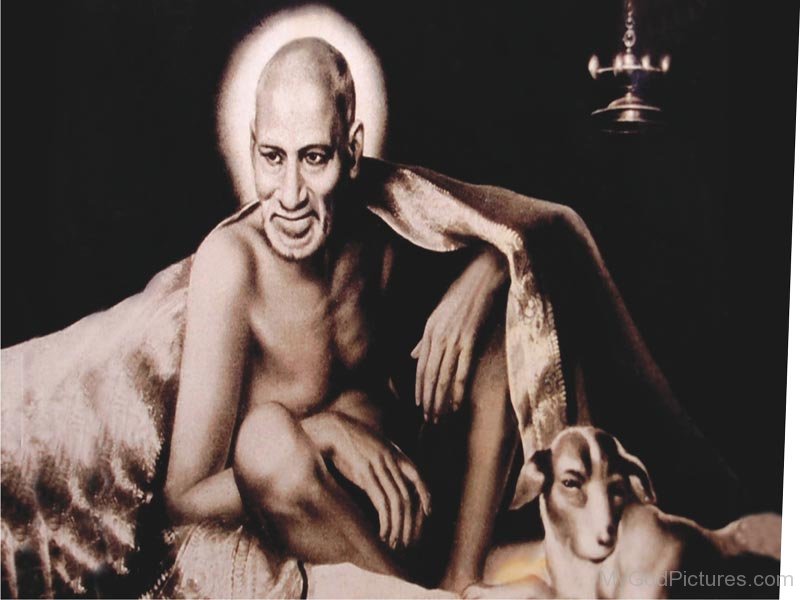
English translation of Adhyay 14. See the Glossary for special terms.
॥ Shri Ganeshay Namah ॥
1. O son of Gauri — I fall at your feet; you should protect the devotees.
2. Listen for a moment to my entreaty; make those big ears worthwhile; hurry to (us); have grace upon (this) child.
3. The pen begins; be helpful at once; let the book prove a crown-jewel — this is my entreaty to you.
4. O Siddhivinayak, Ganesha, giver of intellect, O bringer of joy, remover of sorrow — listen to my prayer.
5. Take the work to fulfillment now; remove obstacles now; otherwise onlookers will kick (it). I place my head at the feet.
6. One who places the head at your feet with faith — him alone you take as your own; you shower grace upon (him).
7. Gana-Maharaj prays: let there be help in the writing of the book; let the heart's desire be fulfilled; the devotee-fellowship will be joyful.
8. Each one is a seeker of release from calamity. When calamities come, he becomes one who entreats at every step. So was Bandu-Tatya.
9. Bandu-Tatya, accomplished in good conduct — his mind reveled in devotion; he did not merely nourish the household, although he lived in worldly life.
10. He had a wife and family; magnanimous feeling in his heart; ever intent on dharma; in that he reveled.
11. Give plentifully in charity; spend money in it; keep nothing in reserve; entrust the burden to the Guru.
12. Doing so, wealth and grain ended; situations of starvation came; took the moneylender's debt; the cycle of interest began.
13. One's fills, the other's ends — such a cycle began. With interest, the moneylender's (house) fills; Bandu-Tatya's house empties.
14. One in sleep, in intoxication, in earning interest; the other in worry, in dejection, in giving the interest of the debt.
15. In the moneylender's house, Bandu-Tatya sows the seed of interest; takes immense pains; pours water of money.
16. At the moneylender's home the trees bloomed; before (his) eyes they spread; Bandu-Tatya's water was exhausted; whatever was — all was gone.
17. Bandu-Tatya's soul withered; (he was) cast in the jungle. Who shall give water to the tree? Only the Lord gives water at such a time.
18. Watching, watching, scarcity came; all relatives became distant; life became extreme; even taking opium became impossible.
19. The courage to take life would not come; the next-life awareness was in his mind; no way to take life occurred to him; even Time would not help.
20. He could not bear to look at the home; the home would not be released somehow; he kept retreating again and again; he was not ready to go forward.
21. But without leaving the house, no other recourse without fleeing. What earlier was a paradise — became its cremation ground.
22. He smeared ashes on his body; took the road to the Himalayas; (his) past merit sprouted; he met a Brahmin.
23. (The Brahmin) said to him: "Don't follow such an act; (you) shall not be free of destined experience; this very (will be) the cause of (your) next birth.
24. By exhausting (it), it ends; by avoiding, it stands ahead. Whatever remains shall have to be borne in the next birth.
25. Invoke the Sadguru; he alone has worry of you. Go to Shegaon; you shall be free of calamity.
26. Don't (take) a ticket to Haridwar, of borrowed renunciation; take the ticket to Shegaon, to wallow in devotion-juice."
27. The crop of past merit had risen, which had never been seen — that began to appear today. Thereby (he) accepted Shegaon.
28. He began to entreat the Master; he held his feet. "I have borne suffering in worldly life; the morsel of pleasure has not remained."
29. The Master gave a vision; recounted the Brahmin's instruction. Bandu-Tatya was astonished; understood the Master's authority.
30. He knew (the Master's) inner-knowledge; would not leave his feet; was not preferring to go home; tortures began to appear.
31. In going back home was Bandu-Tatya's welfare; the Master knew in his mind: "(He should) not stay in Shegaon for nothing."
32. He spoke to Bandu-Tatya: "Go to your home. We shall be in (your) help, when remembered while coming and going.
33. In your farm is Mhasoba; to its east, gold (in) abundance is hidden — yours, baba; don't pointlessly cry out.
34. At night go to the farm; dig under the babhul tree; count four hundred gold coins; be free of the moneylender's debt."
35. A self-interested Guru-command convinces; this comes to manifest experience. So it was with Bandu-Tatya; he set out toward the farm.
36. It pleased Bandu-Tatya; he did so; his poverty fled away; the mind began to sway with joy.
37. Maharaj, Maharaj began to appear; the mind became filled with Maharaj. He paid the moneylender's debt; recovered house and home all.
38. Adornments for wife and children; for himself, ornaments of devotion. The home became as before; the cremation ground became a paradise.
39. The set sun rose; the dawn came in life; one devotee was saved.
40. As (was) grace upon Bandu-Tatya, may it be obtained for you; fortune shall arise; loss of dejection.
41. Although the Master was at Shegaon, (he) was wandering village to village. His devotees too were clever; they knew the greatness of (different) tithis.
42. The greatness of bathing in Narmada — in that, Somvati amavasya — among all convergences, the supreme tithi. The devotee-fellowship knew (this).
43. They were eager for Narmada-bath, for the meeting-meeting of merit; the Master's grace was needed; thereby Saint Gajanan as companion.
44. The thought was told to the Master; the Master was not convinced; the Master would not speak; would give neither command nor consent.
45. When great persons do not consent, they take the vow of silence. This came to experience for the Master's devotees.
46. Maharaj was so; he knew the situations to come; he could not say "no" clearly; he could not break the dear ones' hearts.
47. What is (true) of every mother and father — that became of the Master too. He had not the courage to actually say "no."
48. Three stubborn things are very bad — child's stubbornness, woman's stubbornness, king's stubbornness. To accept any one of them — danger in life.
49. Child's stubbornness fell heavily; situation came upon the Master; came quite unexpectedly; nobody could stop (it).
50. To go to Omkareshvar against (his) wish, not to pain the child-mind, the Master had to go.
51. Knowing the situations to come, the Master could not avoid (them); had to bow the neck before the Creator.
52. One day dawned; (they) set out for Omkareshvar; the watch of the situation began; another (situation) too was as company.
53. All set out for Omkareshvar; all set out for Narmada-bath, to gather merit in the lap, to make the human body meaningful.
54. Even to do a good thing, one has to face the bad. This has not been avoided by anyone; how shall it be avoided by the Master?
55. Each village fell behind; when another village came forward; watching, watching, Omkareshvar came; all began to sway with joy.
56. On the ghat of Narmada — great crowd of men and women; all from afar shall come; shall do tirth-bath.
57. Some descended into the river; began tirth-bath; brimming with devotional feeling; began to immerse the human body.
58. Many kinds of devotees, absorbed in (their) resolves, in many kinds of invocations; some in fulfilling vows.
59. Some absorbed in offering arghya: "Let Sun-Narayan in person, Mother Gayatri herself, come before (us)."
60. Some in praising the greatness of Narmada; some in worry of (their) home; some in tirth-prasad; saying: "Don't (cause) delay in it."
61. After finishing tirth-bath, taking bilva-leaves, going into the temple, offering to Omkareshvar.
62. Brahmins of various branches, knowing the golden opportunity, giving allurements to devotees, convincing them of its importance.
63. Some understanding (it as) duty, properly explaining the rituals, convincing of the tirth's greatness, making life meaningful.
64. Some — pedhe, barfi, coconut — abundance of prasad. Children quite (happy); a walk of joy.
65. Some absorbed in bhajan, in cymbals, mridanga, jhanj. The reverberation in the surroundings; echoes resound.
66. "Don't go forward, child; in searching, (one's) nine (limbs reach the) nose; don't let go of the hand and go; on returning we shall take toys."
67. Together with the devotees, the Master was in such a crowd, but in different thoughts; (he) did not revel in the visible surroundings.
68. Devotees and Master, after finishing the bath, in the temple, became absorbed in Omkareshvar, became absorbed in the OM-sound.
69. The greatness of Omkareshvar (was) spoken to the devotees; was entwining around the devotees; the simple Lord (Shiva) looked very (beautiful).
70. Properly the tirth-bath was done; coming with devotional feeling; expressed devotional feeling; awakened devotional feeling.
71. Did not revel here and there; did not wander here and there; (those who) had truly come — they understood the true meaning.
72. The devotees said to the Master: "Don't (use) the bullock-cart on the return. While making (our) way through the crowd, the bullocks shall not manage.
73. Useless delay shall be much; though (we have) the Khedigaon-station agreement, don't (take) burden on it now; let us take support of the boat itself.
74. By boat let us go to Khedigaon." To the Master's assent — importance of his company — thereby (we shall do) the further journey.
75. What shall Maharaj say? Originally there was a no, but assent for the dear ones; destiny shall not be avoided.
76. Up to Khedigaon by boat — all were to go. Whatever the Creator has decided shall happen, step by step.
77. All sat in the boat; the return journey began; up to here all went smoothly; the devotee-fellowship was content too.
78. What had been served on the plate by the Creator, what was served in it — to know this, the devotees were not so clever.
79. Knew exactly only the Master alone; but his vow of silence (was on); this too is the Creator's craft.
80. The boat began to go forward; began to cut sweet water; the boatman too began to sway; began to look around.
81. Crossed half the way easily, but did not reach the destination; (when) the going-forward was still (left), then the opposite happened.
82. Although the boatman was skilled, in cutting water swiftly, in knowing the direction of water, in knowing whirlpools in water —
83. A wave rose up; struck the boat with a thud; the boat was tossed; recovered again and again.
84. The same happened again; again the wave rose; the boat struck against rocks; the limit of effort was reached.
85. Told the passengers: "Now (it has come) upon (our) lives." All became frightened; clung to Maharaj.
86. In "Gan Gan Ganat Bote" the Master was absorbed; absorption is in his original nature; that itself was happening.
87. Narmada heard the tone; entreated the Master; asked him to give darshan: "Don't go away thus, good (sir).
88. Let all take darshan; why should we be deprived?" Such (was) in her heart; appeared in her action.
89. The situation proved the pretext; Narmada took advantage of the opportunity. "The mystic does not meet me; (he) shall not (come) again to this place."
90. Eager for the Master's darshan; "When shall I meet?" became the state. (She) appeared in the splashing; gazed at the boat.
91. She surrounded the boat; she looked at one boat. (They) felt: she has come to take lives — but the whole estimate was wrong.
92. The devotees ask Maharaj: "Who has come at this moment? What is the motive in her mind? She has put all in calamity."
93. Narmada herself tells all: "I am the daughter of Omkar. I have come to see the Master; this is the motive in my mind.
94. I always remain in water, am always in wet garments; not all know me; I am in (only) someone's fortune."
95. Watching, watching, what spoke became invisible in a moment. All recognized her sign; (they) addressed her as Narmada.
96. Narmada protected (their) lives — rather, she came for the Master's darshan — to ask atonement of (her) mistake; to ask his gracious blessing.
97. What power of the Master! What had been felt as calamity itself came (in) surrender; protected all the devotees.
98. The boat's tossing was seen; those gathered around spoke at that moment: "Now all have drowned."
99. In the Guru's company is protection; thereby the devotee's heart blooms. (They) were being fulfilled; were singing his praise.
100. All the party came to Shegaon; told the news to the village. "Narmada saved us." (They) understood the Guru's authority.
101. May (you) come for the Master's darshan; may daily new situations occur; let them not feel new to the devotees; let it always happen so.
102. Just so it was going on here; one day it happened thus: Sadashiv Vanvale, with friends, came to Shegaon.
103. Disciples of Madhavnath of Chitrakoot, of Guru-Nath; the motive in their mind to take darshan of Gajanan.
104. The Master had sat for the meal, but consciousness was not caught in it. He said to all the devotees: "Where are Vanvale?"
105. He called Vanvale; the Master said to him: "Madhavnath ate here, but he forgot the betel-roll here.
106. Give this betel-roll to Madhav; deliver our message: he should eat at Gajanan's, and forget the betel-roll there."
107. Vanvale was astonished; he then went to Chitrakoot; told Madhavnath; gave him the betel-roll.
108. Madhav told the disciples: "Our symbolic things go on; the secret in them you shall not understand." So saying, he saw them off.
109. Such symbolic talking, of Gana-Maharaj and Gajanan, at times of conversation — this too is all of right convergence.
110. By name-japa obtained for Gana-Maharaj — may such fortune arise for you, all the devotees. This is the prayer to the Lord.
111. Gana-Maharaj's prayer: may the joy between the two be obtained for all; may the glory of the Name be known to devotees; the Name alone shall uplift all.
॥ Shubham Bhavatu ॥
॥ Offered to Shri Ganapati and Saraswati ॥
॥ Thus ends the fourteenth chapter of Shri Guru Gajanan Leela Granth ॥