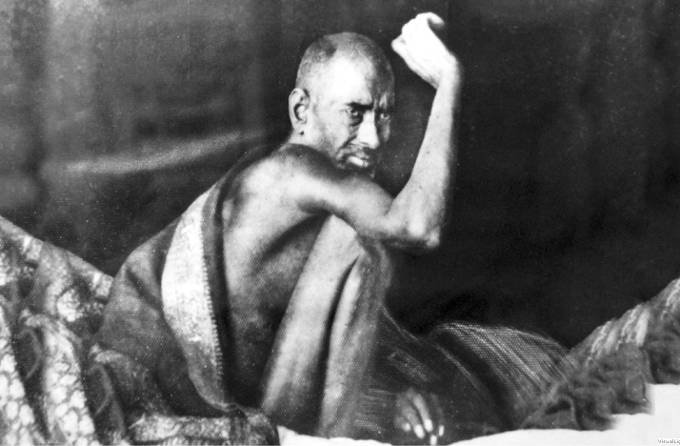
English translation of Adhyay 19. This chapter recounts Maharaj's mahasamadhi (1910). See the Glossary for special terms.
॥ Shri Ganeshay Namah ॥
1. O Lord, Supreme Being — coming forth from the formless, going back from the form.
2. O Narsimha, Shri Krishna, Shri Ram, Beloved of Gauri — come to my place, to fulfill Saraswati's heart's desire.
3. The surrounding atmosphere intoxicates my mind. How shall the writing of the book happen? How shall I become absorbed in it?
4. Don't catch (me) in it; if I get caught in it, the book shall not be completed; the heart's desire shall be broken.
5. O Supreme Lord, preserver of joy — hurry to (us); have grace upon this child.
6. I make the entreaty again and again: let the pen continue. Without your grace, the pen does not run.
7. You alone listen to me; thereby I entreat you; invite (you) again and again; keep faith on you.
8. You meet (us) in different forms; you should meet the devotees in those forms; (they) shall keep faith on me; otherwise no one shall remain in faith.
9. Thereby there shall be decline of devotion. You alone (are) the cause of your decline; you alone of your destruction; I am not the cause of the fault.
10. O all-knowing, formless Supreme — don't make (me) destroyed; know this motive a little.
11. Whatever schemes (we have) in mind, the Lord knows them precisely; likewise, whatever (the devotees) have in mind, the Master knows.
12. Kashinath Garde, one devotee — whatever motives he had in mind, Maharaj knew them; achieved them on time and circumstance.
13. Garde Kashinath of Khamgaon knew Maharaj was certainly a yogi; (the) thought always came to mind to experience yogic-leela.
14. He came for darshan of Maharaj; the thought of job in mind. The Master knew through inner-knowledge; convinced Kashinath.
15. The Master gives a (gentle) jab; thereby suggests to him: "The postman (is) at your door; your post (is) in his hand.
16. The news of your transfer is in that post." (He) was astonished. "How does the Master know?"
17. (He) bowed in humility; began to ask blessings; took prasad and set out; came home.
18. He saw the very scene: a telegraph-man came with a telegram; read the message in the telegram — transferred to the post of munsif.
19. Nothing came to mind from joy; nothing was visible without the Master; could not stay without saying "yogi"; (he) felt (he) should go for darshan again and again.
20. Again Shegaon was remembered; Maharaj was remembered; (he) made salutation in mind; (he) felt (he) was at Shegaon itself.
21. As we have to go out for work, so Maharaj used to go; was fulfilling devotees' heart's desires.
22. Here a great difference is felt: we live for ourselves; fill only our own pouch; the yogi lives for another.
23. (He) had to go to several villages. So once to Nagpur, to Gopalbuti's home — went to give blessings.
24. Gopalbuti's grand mansion, splendor and wealth (in) abundance; even Lakshmi-Narayan, eager, chose the mansion.
25. All is obtained by Guru's grace; only by Guru's grace it endures; nothing is one's own — this truth (he) knew.
26. Maharaj went to his home; song-bhajan-kirtan from time to time; the showers of knowledge raining; waves of (sacred) sound were rising.
27. There was give-and-take of knowledge; no one had the courage to stop it; (these were) signs of fortune.
28. Each was in joy; in forgetting pleasure-sorrow; was being satisfied to (his) heart's content; was enjoying joy.
29. (He) was taking each one to (his) home; was gathering (people); none was stopping; each was independent.
30. Such was the karmic motion that was running smoothly; the rows of meals — one rose after another.
31. The merit of food-distribution to that Buti — came in his fortune; (he) was tucking (it) in (his) waist; was being fulfilled in mind.
32. Each moment that came would stay right there; he had no thought of moving from there.
33. Merit-moments were growing; not decreasing; the surge of good qualities; the relationship with good karma was joined.
34. The household of Gopalbuti — what to ask of them! (They) said: "Great is our fortune"; this they kept saying.
35. What was in one's fortune mixed with another's fortune; doubled the joy; everything was happening spontaneously.
36. But to all this (was) a defined limit. The Creator knew; Gopalbuti did not.
37. The Creator is not of one (person), (he) is of all. To convince all of this — was the motive in his mind.
38. Everything happens at the right time; nothing is to be done deliberately; happens by coincidence; happens precisely at the decided time.
39. As much joy in the mind for Gopalbuti of Nagpur, so much torment of separation from the Guru for Hari Patil at Shegaon.
40. (He) was writhing from separation; thereby his mind uneasy; (he had) no attention in business; no (attention to) sleep and meal.
41. As when a child's mother goes to another place, the state that the heart becomes — that he was experiencing.
42. Hari became very impatient to meet the mother; he could not wait; became quite restless.
43. The mind's balance went; (he) began to talk to himself: "Let us go to Nagpur right now, to Gopalbuti's mansion."
44. The day passed in thought; but one day dawned; he finally went to Nagpur, to bring Maharaj.
45. Maharaj knew this through inner-knowledge; called Gopal; told (him) at that moment.
46. Gopal understood in mind; pain of separation came to him: "Maharaj shall leave us; now (we) shall miss the joy."
47. "(I) cannot say no to Maharaj; (I) cannot let go of the Guru's feet; without the Guru's feet, I shall be empty."
48. While the food-row was going on, Hari Patil came; "When shall I see the Master?" — so it became for his consciousness.
49. Maharaj recognized the situation; explained to Buti: "Don't fall to insistence; Hari has come to take me."
50. Here the meal row, wheels of thought in Buti's mind; half attention on the row, half on the next thought.
51. He entreated Hari: "All have sat for the meal. Maharaj should not be taken at such a moment."
52. Buti insisted to Hari Patil for the meal: "Sit for the meal first; then go to Shegaon.
53. If you take (him) right now, confusion shall arise truly; if Brahmins rise hungry, sin shall come into my lot."
54. The speech convinced Hari; (he) gave consent for the meal; let the meal happen; joy came to Gopal.
55. Gopal felt: "Let no moment pass; let Brahmins be caught in the meal; let me get to tuck even that much merit."
56. Greatly hungering for merit, not ready to let go of the Guru. After the meal was done, Maharaj got up to leave.
57. Gopal's voice fell silent; tears came to (his) eyes; husband and wife fell at the feet; said: "(My) wish has remained unfulfilled."
58. (Maharaj) recognized her motive; applied kumkum on her brow; gave her blessings. Later she had a son-jewel.
59. Maharaj tells the devotees: practice such devotion; prove worthy of blessings; prove worthy of Guru's grace.
60. While returning to Shegaon, gave darshan to many; went to Sitabardi; went to Ramtek.
61. Maharaj came to Shegaon; the devotee-fellowship was waiting for him; each came for darshan; took blessings and went.
62. Once Maharaj told Balabhau through inner-knowledge: "(Some are) coming for darshan to the Shegaon math.
63. Vasudevanand Saraswati, dwelling at Mangaon, very eager to meet, shall come tomorrow for sure.
64. Likewise Rangnath of Dhar, eager to meet, shall come to Shegaon, certainly tomorrow."
65. Next day so it happened; both came there; symbolic talk took place; Balabhau was astonished.
66. The Master said to Balabhau: "If (one) goes by karma, devotion, yoga, you shall reach the path of knowledge; thereby knowledge will be obtained.
67. Vasishtha, Vamadev, Jamadagni, Atri, Parashar, Shandilya muni — followed the path of karma; crossed the worldly ocean.
68. Vyas, Narad, Kayadhukumar (Prahlad), Shabari, Maruti, Akrur — eager in the path of devotion; crossed the worldly ocean.
69. Macchhindra, Goraksh, Jalandar — eager in the path of yoga; though the path of yoga is very difficult, by it itself (one) crosses the worldly ocean."
70. The Master had many devotees; (he) would take some near, push some far; (it) happens according to past accumulation.
71. One day to Salu, Maharaj said to her: "Don't leave the math; stay for the cooking."
72. The thought convinced Salubai; she took the Guru's command (as authority); stayed there at the math; (she) fed all.
73. To Tulsiram of Jalamb village, Atmaram (was) a son; he had to go to Kashi for Vedic study.
74. Atmaram became expert in the Vedas; came back home; would come to Shegaon; would sit in the Master's company.
75. (He would) recite the Vedas before the Master; wherever there was mistake in reciting, the Master would bring (it) to attention; Atmaram was astonished.
76. Correcting mistakes according to situation — this was the Master's habit. Devotees would come from time to time; would realize their mistake.
77. The Gurus are ready to awaken devotees; Maharaj was doing that very (thing); the devotees were experiencing this.
78. Such a situation of one devotee, of Balapur taluka, of Marutipant of Morgaon — protecting the sorghum field.
79. Marutipant of Morgaon was endowed with farms; had a religious disposition; was always intent on dharma.
80. (He) employed Timaji as a worker, to guard the field, to experience peace.
81. Timaji used to guard the field; was thorough at the job; never deceived; behaved with honesty and trust.
82. However work-vigilant a worker, by mistake he becomes prey to (master's) anger. Such a situation came to Timaji; he had a lapse.
83. While guarding the field, after much of the night had passed, (he) gave (himself) to a doze; an adverse situation came to be borne.
84. Watching, watching, doze came; donkeys entered the field; began to eat the heap of sorghum; the field was ruined.
85. The Master knew through inner-knowledge; but did not stay still — this Guru-Mother — came there at that moment.
86. Began to call out to Timaji; the Guru-Mother said to Timaji: "Hey! Donkeys have entered the field." Timaji woke up.
87. Realized his mistake: this doze fell heavy. (He) made hubbub in a moment; remorse came to him.
88. Sleep made confusion; did harm to oneself. (He) began to invoke compassion: "Save me from this."
89. Afterward he stayed awake; in the morning went to the master; told all the news; Maruti became greatly angry.
90. Whichever master would (want) loss to come to him? No master wants loss. Marutipant was in that very thought.
91. But (he) was in Guru-service, eager to do darshan; in the morning would go to the math first, and only then to the field.
92. This very routine was followed strictly; a change would not happen, even if (it was) a situation of profit-loss.
93. Guru-service shall not go in vain, however difficult the situation. Marutipant knew; thereby he was behaving so.
94. Although loss happened to him, he said to Timaji: "First (I) go to the math; then come to the field."
95. First went to the math, for Maharaj's darshan; made salutation to him; said: "Have grace upon us."
96. Maharaj said: "Marutipant! You keep a sleepy worker; donkeys make confusion; (you) break our sleep."
97. The trouble caused to the Guru — was not bearable to him; (he) said to the Master: "I shall remove the worker from the job."
98. Maharaj said in reply: "Hey! Timaji is an honest worker; (his) sorrow became uncontrollable; as if the situation were upon (him)self.
99. When you met (him) at dawn, you said to him: 'First (I) go to the math; then come to the field.'"
100. The whole news convinced (him); Marutipant was astonished; experienced the Master's inner-knowledge.
101. Took the Guru's command as authority; kept Timaji in the job. Gurus protect devotees — the experience came to both.
102. Maharaj's was just so; would never stay still; would sit wherever (he) pleased; would forget time and circumstance.
103. So once on the highway, in front of Sukhalal Bansilal's shop, in naked state on the road, a situation befell the Master.
104. Narayan Asaraji the constable saw the affair: "A naked fraud on the road; each makes salutation to him."
105. This did not please him; (he) began to scold; began to drive Maharaj away; began to beat (him) with sticks.
106. The talking had no effect; Maharaj would not move from (his) place; explained to him in many ways, but (the constable) would not utter a peep.
107. Watching, watching, a crowd gathered; began to look at Maharaj; felt compassion for Maharaj; began to look toward the constable.
108. The constable scolded: "Get out of here." Saying so, raised the sticks; thrashed some.
109. One among them came forward; began to explain to him: "Don't beat," (he) began to say; began to draw (him) aside.
110. But the constable-pride awakened: "I shall thrash more; shall beat (him) up; (he) roams naked in the village pointlessly."
111. Just then the hundi-shop owner could not bear the scene; he restrained the constable; sent all the people away.
112. He went to Maharaj; held his hand; said: "Come to my shop; I shall give you water."
113. Here (people) explained to the constable; told him to ask pardon; the constable refused; this very (became) cause for the next.
114. Because (he) beat Maharaj, Time surrounded him; (he was) raised from (this) earth-realm; later the whole household was destroyed.
115. If a holy man is beaten without cause, (it is) cause for bad consequences. So it happened to the constable.
116. Maharaj was the Master; (it) was being convinced to people; (they) were bowing in salutation; were taking blessings.
117. Each was not letting go the chance; each was coming according to his (means); was asking near him; was prostrating.
118. Devotees of Sangamner, Nagar district, would come there; many motives in mind would be achieved by darshan.
119. Hari Jakhada from there — he too heard. "There is one Master at Shegaon" — he too became eager for darshan.
120. Hari Jakhada used to beg; sometimes (had) starvation; was tired of life; the soul had no peace.
121. Whose soul would like that troubles come to him, that pinches happen to (his) belly? Each was eager to avoid troubles.
122. Hari Jakhada too was among (such); came to Shegaon hopefully; fell at the Master's feet; began to weep profusely.
123. Did not let go his feet; (he) would not leave without blessing. The Master knew his mind; said: "May (your) heart's desires be fulfilled."
124. The Master said to Hari: "Why this coming here?" Hari said in reply: "(I have) come for the happiness of household life.
125. (I) fill (my) belly by begging; sometimes remain hungry; I am Daridra-Narayan; who shall give a beautiful daughter (to me)?
126. Wealth-grain-property, the pleasure of (a) wife, offspring — (I) ask of Maharaj; let Maharaj fulfill them."
127. Maharaj spat on him, on his ignorance, to bring him to (his) senses. The Master said to him:
128. "Each entreats for release, not for entanglement. You have come for entanglement. May the Lord-of-the-world be helpful."
129. Some near Maharaj ask for enjoyment; some say "Cure the disease"; some ask for the convergence of learning; as is each one's (own) convergence.
130. Nimonkar was among (them); came to ask for the science of yoga; was earnest about that itself; that (very thing) he prayed for.
131. Ramchandra Nimonkar was an overseer; with him Vasudev Bendre, surveyor; came to the Mukna river.
132. In the Sahyadri mountains, the Mukna river in the hills, in Nashik district, in Igatpuri taluka.
133. Came on one parvani (auspicious occasion), to do tirth-bath. Crowd gathered at the stream, at the Kapildhara flow.
134. Ramchandra Nimonkar was learning yoga-practice; for it to reach completion, asked the sadhu there.
135. But no one of capable quality was visible; thereby the thought of learning yoga remained as it was; finally became disappointed.
136. After bath finished, Nimonkar got up; sat on the bank; one sadhu (came) into sight.
137. Saw that sadhu, with arms reaching to the knees, sitting in samadhi; saw the ray of hope.
138. His samadhi would not descend; no answer was obtained; the motive was not fulfilled; but (he) could not leave from there.
139. Thus one day passed; Nimonkar remained hungry; the longing was settled in heart: how to do yoga-practice?
140. The sadhu was clever; was taking the test; was keeping (him) waiting; was seeing if (he would) return.
141. Nimonkar was of perseverance; he was not weary; he was needy; was ready to do whatever.
142. The sun set; the sadhu descended from samadhi; saw Nimonkar; began to sprinkle water on him.
143. Held the sadhu's feet; pleaded for yoga-practice. The sadhu smiled; raised Nimonkar (up).
144. The sadhu said to him: "Yoga-practice is very difficult. Don't go on (this) path; yoga-practice shall not (be) for you."
145. Nimonkar did not let go of the stubbornness; entreated him again. The sadhu gave him a chart; said: "(It) will fulfill the heart's desire."
146. Gave a red stone as prasad. Nimonkar set out from there. Later this same sadhu was seen at Nashik; refreshed the past memory.
147. Asked the sadhu (without) telling (his) name and place: "Why did you become missing? Did you not give the chart?"
148. The sadhu said to Nimonkar: "You remained foolish. The red stone (I) gave (was) to convince of the sign.
149. My name is Gajanan; what more shall I convince of the sign? Don't (give) place to doubt; do practice keeping faith."
150. Both set out together; both began to walk on the way. In a moment Gajanan became hidden; Nimonkar was confused in mind.
151. Nimonkar continued forward; reached Dhumal's residence; this same sadhu was seen there; astonishment came to Nimonkar.
152. Told the news to Dhumal; Dhumal understood in mind; was happy in mind; he said to Nimonkar:
153. "That red Ganpati shall teach you yoga-practice. That chart and Ganpati — know in heart as Gajanan."
154. Such were the Master's devotees; heart's desires would be fulfilled. Tukaram Kokate was among (them); was living at Shegaon.
155. Tukaram's offspring could not survive; he began to do devotion; said: "Let offspring dwell at home."
156. So he began to do devotion; one good day dawned; settled at the Master's feet; asked for offspring.
157. Said to Maharaj: "If offspring survive, the eldest son I shall offer to you."
158. Later, two-three children were born; (he) became absorbed in joy; the memory of the vow did not remain; (he) became entangled in worldly life.
159. By the illusion of worldly life he forgot the vow; the eldest, Narayan, fell ill; medical treatment began, but no relief came.
160. He became anxiety-ridden; (he) remembered the Lord; made prayer to him: "Let relief come to (his) health."
161. After some time, (he) remembered the made vow. (He felt) the illness came on forgetting the vow; so the mind began to say.
162. Began to entreat Maharaj; made prayer to the Master: "You alone save Narayan; let relief come to the illness.
163. Tukaram says, 'Sadguru-king, save (my) son Narayan. If this son survives, (I shall) come to offer (him).'"
164. Thus he became bound by vow; the pulse came to (its) place; (Narayan) opened (his) eyes and saw — the son survived (when about to die).
165. When the disease became cured, Tukaram came to the math; said: "I offer Narayan at your feet; please accept the vow."
166. As Narayan at the Master's feet, Tukaram offered (him); keeping awareness of the vow, became free of the vow.
167. So came remembrance to Gajanan; the awareness of the vow came to him: to offer the body to Vitthal, on completion of the work.
168. As Narayan in (Tukaram's) command, in Gajanan's word, so Gajanan in (Vitthal's) command, in Vitthal's word.
169. To fulfill his own vow, awareness began to come to Gajanan; (he) said to Hari one day: "Let us go to Pandharpur."
170. For Vitthal's darshan, to fulfill the vow, to take the gracious blessing, to take the gracious prasad.
171. Then in Shake 1832, in Sadharan Nama Samvatsar, in the month of Ashadh, (they) went to Pandharpur.
172. Maharaj said to Vitthal: "I have remembered the vow made; my work is over; the fulfilling of the vow has happened.
173. On this year's Rishi-Panchami, I shall fulfill the vow; please accept it; engage me in the next work."
174. Separation became felt by the Master; the throat became choked; tears flowed down the cheeks; Hari just kept watching.
175. Maharaj said to Hari: "The vow was to Vitthal; I came to fulfill it, to complete it.
176. Hari, now (our) company is little remaining; Rishi-Panchami has come near; the time of going has come; Vitthal's command has come.
177. 'On this year's Rishi-Panchami, I shall finish the avatar-work; (I) shall remain in your inner being; on remembrance, I shall be seen.'"
178. Hari said to Maharaj: "Don't leave us. You alone are the support to us; don't make (us) children helpless."
179. Hari understood the meaning; said: "(Stay) a few days, Master. Vitthal, don't (cause) calamity; let the Master live long."
180. From Gopalbuti's mansion, Maharaj was snatched away; that itself (is) called destined experience; an experience does not let go without bearing.
181. Tears came to Hari's eyes; the next picture began to appear; the cheerful mind set; tones of disappointment came to (his) ears.
182. Both circumambulated; began to take Vitthal's darshan; a different experience came; the mind dejected at that moment.
183. Both returned to Shegaon; the villagers learned all; but no one took (it) as true; maya tricked all.
184. Hari said: "The boat shall go to the further shore; (he) shall not be seen by us again. Only memories shall remain; the formed shall become formless."
185. The month of Shravan came; bodily experience proved the pretext; that itself became the cause; made the next situation eloquent.
186. Then Bhadrapad came; the day of Ganesh Chaturthi came; the Master held Balabhau's hand; seated him on his own seat.
187. "(There) was Vitthal's help; until then (this) body was (here); our work has ended; from tomorrow (it is) your work."
188. In Shake 1832, in Sadharan-named Samvatsar, on Thursday Rishi-Panchami, around eight in the morning —
189. on 8 September 1910 — (he) ended the avatar-work; obeying Vitthal's command, went to the next work.
190. That very (day) became the samadhi day; (he) left all behind; he himself went forward by command; merged into the Infinite.
191. Lived with such action; showed wonder; useful to all — for that itself the avatar.
192. Proved the support to all devotees; put all on the path. How shall (one) forget him? In forgetting, decline shall happen.
193. Maharaj had gone in body — was known to all. Watching, watching, all gathered, having come quite from the heart.
194. Went into some devotees' dreams; spoke of the next abode. Devotees became grief-stricken; came to Shegaon with distressed minds.
195. Crowds upon crowds rose up; flooded for last darshan. Each came to Shegaon; the whole family became dejected.
196. (They) said: "Let the Master become eloquent; let the wonders of yogic-leela happen; let (he) fulfill heart's desires; let blessings be obtained."
197. To Govindshastri of Dongaon, this thought did not please. He said to the devotee-fellowship: "Don't entreat him so.
198. If entreated, the Master shall arise; shall give darshan to devotees; shall surely become eloquent — but it shall not please the Lord.
199. What pleases the Lord — that (one) should do; one's own saying should not be made true; should not give trouble to the Master; let him lie peacefully."
200. All the devotee-fellowship lamented; preparation of the palanquin was made; here bhajans went on; the company of name-resounding came.
201. Watch upon watch, of themselves, went absorbed in bhajan; doing mantra-chant and resounding; becoming filled with Maharaj.
202. Time was as company; (they) did not have to wait for it; were saying "Gajanan, Gajanan"; were forgetting body-awareness.
203. Women, children, the aged — there gathered the devotee-multitude; each was ready for darshan; this very motive pure in mind.
204. Saw Maharaj — "(he) shall not be seen by us again" — this very motive in their mind, by which (they) came for darshan.
205. The palanquin became ready, decorated with flower-garlands; the start of last rites began; the start of mantra-chanting began.
206. Maharaj was given a ritual bath; (water) poured all over the body; abir-gulal tossed; (he was) decorated with garments and ornaments.
207. Maharaj was placed in the palanquin; flower-garlands offered; devotees took final darshan; bottled tears were freed.
208. The palanquin (was) paraded in the village; old and young all gathered; began to say "Jay Gajanan"; began to make salutation to the Master.
209. All devotees became orphaned; living and non-living lamented; the atmosphere became choked; something different began to be felt.
210. The color of bhajan was different; (it) asked for the company of tears; the speaking became silent; the silent became speaking.
211. Even in the mockers' hands, cymbals were seen; in the rhythm of jhanj-cymbals, bhajans were being sung.
212. Brahmins' mantra-chanting; in it the samadhi arrangement; final darshan to all; a different atmosphere altogether.
213. Abir, bukka, gulal — old and young were tossing; women and children too taking part; who would let them go?
214. In disposition were grateful feelings; the people were expressing them; compassionate, gracious Gajanan, lived having forgotten himself.
215. All night the palanquin (was) paraded; mantra-resounding gave company; next day in the morning, the palanquin came to the math.
216. On the place of samadhi, the Master was placed upon (it); rudrabhishek was done upon (him); five-fold worship.
217. After panchaarti, salt, abir, argaja on the samadhi; devotees made name-resounding; a stone was placed upon it.
218. The light that had come from the Infinite — went back to the Infinite. Mass-feeding continued for ten days; many devotees took prasad.
219. Maharaj took mahasamadhi; the devotee-fellowship lamented; before destiny nothing prevails; began to say "Jay Gajanan, Jay Gajanan."
220. To the inner mind of devotees, Gajanan tells them: "On making remembrance to us, (we) shall give darshan to you."
221. One who incarnated for devotees, who lived only for devotees, shall revel only in devotees, kept (them) ever awake.
222. Speaking even after samadhi, contemplating the welfare of all, ever proving helpful — Saint Gajanan, truly the Master.
223. Gana-Maharaj tells the devotees: don't forget mantra-japa. On remembering Gajanan's mantra, Gajanan shall be seen by you.
224. Sat-Chit-Anand Gajanan ever protects the devotee-fellowship; those who do mantra-recitation, their calamity is removed.
॥ Shubham Bhavatu ॥
॥ Offered to Shri Ganapati and Saraswati ॥
॥ Thus ends the nineteenth chapter of Shri Guru Gajanan Leela Granth ॥