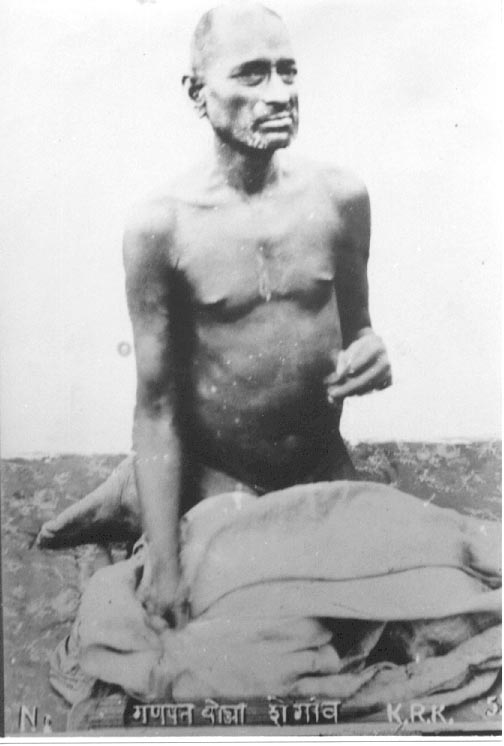
English translation of Adhyay 4. See the Glossary for special terms.
॥ Shri Ganeshay Namah ॥
1. O Goddess of Speech, Mayureshvari (Saraswati) — your dwelling is in our home; how shall ignorance remain in this house?
2. The world's importance is in knowledge — not in mere wealth. For the accounts of wealth, knowledge is the cause of yield.
3. Wealth entangles in worldly affairs; the soul is greatly caught in worldly esteem; the measuring of money goes from door to door; money itself wearies one.
4. Attachment and illusion torment greatly; their kingdom is in every house; with wealth as medium they roam about and wound the heart.
5. When there are heaps of ignorance, the wealthy man remains hungry — though he has innumerable heaps; but the wise man eats with ghee.
6. Here ghee shows the connection — shows action and process; shows the connection of essence (sattva), which proves to be life's support.
7. In life, principle has great importance; likewise sattva (essence) has great importance. Where these have primacy, how shall destitution endure?
8. The army of destitution does not afflict the wise man; its destruction comes effortlessly — this is the experience.
9. This is the play of the wonders of that Creator of the world. To preserve the divine sovereignty — that alone shall be his purpose.
10. This truth is known to the wise; this comes to manifest experience: all is the leela of the Lord. He says: do not give yourself importance.
11. Gana-Maharaj prays: "O God! Make me write," he says. "Remove ignorance," he tells; "make me wise," he says.
12. Let Shri Guru Gajanan's leela come into writing in such a way that, on reading, joy comes to the mind, and each tells another.
13. Whoever does the recitation of this shall not wander aimlessly. Ignorance shall flee; knowledge shall settle in.
14. Where Saraswati herself writes, where Ganapati's gracious gaze is — what could be lacking? Everything will be excellent.
15. The Guru's leela proves fulfilling — sweet stories, one by one. Among them is one — the story of fire-creation.
16. In one Vaishakh month, on the day of Akshay Tritiya, such a wonder happened that it remained imperishable.
17. The Guru does not perform wonders — they happen spontaneously in his action. The will-power is so supreme that whatever is in thought happens.
18. They are not magicians, who deceive the eye, who make things appear for a moment, who fill their bellies thereby.
19. The magician depends on tricks and optical illusions, on verbal cleverness, on creating an atmosphere.
20. Saints are entirely different. They have no such display. They reveal what is in the inner being; they remove the eye's defects.
21. The magician's aim is to fill his belly — to entertain spectators. Saints' conduct is such that teaching comes naturally through action.
22. The magician's actions are deliberate; they don't happen spontaneously. By the saints' good conduct, action happens spontaneously.
23. There is purity of mind, sattvik nature of mind, compassion and graciousness, vitality at every step.
24. Entertainment does not remove sorrow; it forgets it for a moment. Diversion lasts but a moment, but worry and anxiety do not depart.
25. Saints, by the Name alone, remove devotees' sorrow. He who becomes the saints' own becomes free from sorrow.
26. He who becomes free from sorrow is always with the saints. He counts entertainment as trivial; he stays only on the Name.
27. On Vaishakh Akshay Tritiya, importance lies in the gifting of pots; one should satisfy a Brahmin, by which gods and ancestors are pleased.
28. Gods and ancestors are not pleased by mere pot-gifting; they are pleased by good deeds and good conduct.
29. What mother and father would have it in mind that calamities should surround their children?
30. While alive, mother and father guard their children every moment, telling them to abandon bad deeds and stay among good deeds.
31. Based on their own experience they guard their offspring. Where there are such impressions, those memories endure.
32. Importance lies in the Guru's leela — not in word-leela. Importance lies in the event — Akshay Tritiya.
33. In one Vaishakh month, on Akshay Tritiya day, in the morning Maharaj was with the devotees, with the children.
34. Maharaj was in the trance of name-repetition; the children were playing about. Maharaj was not bothered; each was in his own absorption.
35. The Lord is in the children too. He who knows this truth — how shall he push them away? He sees the Lord in them.
36. Maharaj had a passion for name-repetition; in that he became absorbed. Likewise a passion for the chillum — but no addiction to it.
37. Sometimes in the trance of name-repetition, sometimes in the intoxication of the chillum — none could stop him; who would get involved in such matters?
38. Going against Maharaj's habits, things go awry. Without the Lord's connection, nothing seems sweet.
39. Each is eager to connect, always avoiding troubles. He won't get involved in matters — but the fingers of the hand are not all alike.
40. That morning, the chillum was not lit. The Master sat just so, the chillum lying aside.
41. The chillum needed Vaishvanara (fire) to be lit. He was looking for such a person who would give him fire.
42. He called the children; he asked for embers. The children spoke among themselves: "Where shall fire be obtained?"
43. There the need was for fire — for one element. If that element is missing, what would the state be?
44. The body too is composed of the five great elements; the Master knew this. He would not depend (on others); but according to the time, actions occur.
45. Fire was the pretext for the chillum; the Master spoke to the children. But the true principle of life — to hide it is not useful.
46. In the world only sattva endures, only truth endures. He who lives by this principle alone becomes immortal.
47. The saints' connection is with truth — not with mere body. Each of their actions is such that wonder occurs.
48. Children are very clever; they know quickly where what is to be obtained; they don't ask anyone.
49. Before the children's eyes, Janakiram the goldsmith — without fire there is no trade — they thought: "He alone shall give Vaishvanara."
50. All the children ran; they sped to the goldsmith. The Mother stayed there, watching the children.
51. The children said to the goldsmith: "Sheth-ji, we have come to your house with one request. Don't hurt the children's feelings."
52. The goldsmith said: "Why such children's feelings, that you come to my house at the morning hour?"
53. The children said: "Today the Guru-Mother is sitting without his chillum. Without fire the chillum won't catch.
54. The Mother's chillum needs fire. We have come to your house to ask for that fire."
55. The goldsmith heard everything; with a shake of his head he refused. "Asking from me means he is not powerful.
56. One who calls himself a yogi roams the streets naked, with no rules of conduct, mumbling whatever comes to his mouth.
57. On Akshay Tritiya day, fire should not be given out." What did he understand of children? He scolded the children.
58. "That naked madman knows the leela of yoga — why didn't he create fire? You sent them to my house!
59. Let him make Vaishvanara himself by his yogic strength!" He scolded the children and put them out of the house.
60. He sent them back, saying: "Now I am free of trouble; in keeping customs my life has been spent."
61. None is free from karma without bearing its fruit. From the account of birth after birth, none is free.
62. Karma is connected to circumstance; behavior at that time — fruits will be accordingly. This is the principle in the Gita.
63. The bond of karma and action — who shall dissolve it? He who attempts such — his transactions become unsuccessful.
64. He who falls into such matters — calamities of themselves come to his door. All remedies tire out; the Guru's feet must be held.
65. So it happened with Janakiram. He didn't recognize Maharaj. He sent the children away likewise. That itself became the cause of trouble.
66. The children returned to Maharaj with downcast faces: "Janakiram won't give fire; he sent us away thus."
67. Maharaj did not get angry over it; he wouldn't behave tit-for-tat. His trust was on the Lord. He thought: "What shall happen today?"
68. He said to Bankat: "Hold a stick like this — not connected with the matchbox's sulfur, but with the principle that manifests fire."
69. Bankat did so. He held the stick up. All gathered around; they began to stare.
70. When Maharaj gazed steadily, he invoked it inwardly. By the call of the inner soul, fire manifested right there.
71. Such was the strength of yoga: fire was forced to manifest. All happened spontaneously. Maharaj proved powerful.
72. Here Janakiram learned the news. He was astonished; likewise his mind trembled.
73. "I acted very thoughtlessly. Calamities will surround me. Who will help?" The goldsmith fell into thought.
74. By Dasharatha's hand, Shravan met his death — unexpectedly it happened — but Dasharatha was not freed from it.
75. Today here, by provoking Maharaj, I have deliberately become the cause; now the situation is dire.
76. The fever of thoughtlessness was upon him; mental anguish came to him; remorse arose; words came spontaneously.
77. That too happens spontaneously. The inner being unfolds. What is bottled up comes out. How long shall it remain bottled?
78. There no instruction is needed, no doses of preaching. All is the leela of the Lord, of the One who has set the play.
79. In Vidarbha, on Akshay Tritiya, importance lies in chinchavane (tamarind dish). Relatives gathered for the meal at the goldsmith's house.
80. In Janakiram's mind: "Let us gather relatives; with chinchavane in the meal the relatives will be content."
81. The thought was good — what worldly esteem can afford. People are companions in pleasure; saints are companions in suffering.
82. Worms fell into the chinchavane; the invited guests remained hungry; they began to grumble; it became a cause of embarrassment.
83. The sin of starving (guests) fell into the goldsmith's fate. He could think of nothing; the water from his mouth fled.
84. He became frightened in a moment — worms appearing in the chinchavane. He was confused in mind: "What has happened in the kitchen?"
85. Confused speech came from his mouth; sweat poured down; nothing occurred to him.
86. The morning's troublesome event was avoided, but a great calamity arose. For a moment nothing came to mind; the kingdom of confusion arose.
87. Saints and the Lord preserve their own existence. How shall this prove false? They become immortal through wonders.
88. Saints' hearts are tender; they take all close. They show yogic strength; calamities become fruitless.
89. Power is in the saints — seen in their actions. Such was the powerful Gajanan; it became known to Janakiram.
90. Some told Janakiram: "Take refuge with the yogi. Take refuge with Gajanan; thereby you shall be free from calamity."
91. Janakiram said to the people: "I did not give fire for the chillum. Therefore in such a situation, I have no courage to take refuge."
92. Janakiram thought: "I have hurt Gajanan; thereby he became inwardly angry; thereby the chinchavane was spoiled."
93. How is ignorance? The Master is not a common person. By such tricks one acts; but the Master is the cloud of compassion.
94. A yogi will not get involved in trouble. He who is by nature free from troubles will not perform such an act, which would prove to be a misdeed.
95. The saint, the yogi, is a remover of calamities — not a maker of calamities. He is a remover of obstacles — not a maker of obstacles.
96. When you see with faith, when you worship with faith, when you place your head at the feet — he himself is your savior.
97. By faith all is obtained; by lack of faith all is lost. Those who relied on faith — all have crossed over until today.
98. He went to take refuge with Maharaj; he held the Guru's feet; he began to plead: "Have grace upon this child."
99. With remorse he spoke: "I did not give fire for the chillum. Thereby this situation was drawn down. None proved helpful.
100. Guru, perform such an act that my calamity is averted, that the worms in the chinchavane are removed, that the relatives do not stay hungry.
101. I went to do a meritorious act, but became the cause of sin. You alone shall save us; this comes to experience."
102. The Master's heart melted; he took him close: "I did not spoil your chinchavane; in vain did you come.
103. Hey goldsmith! I shall not lie. Your chinchavane is sweet; how can there be worms in it?"
104. All the people heard. The chinchavane was looked at again. It appeared as before, with not a single worm in it.
105. All people were astonished; they understood the Master's authority. They held the Master's feet and became his devotees.
106. Now what happened next? It must be told. In Jyeshtha month such a thing occurred. Chandu Mukin's fortune arose.
107. Whose house the saints ask of — that house becomes blessed. So it happened with Chandu Mukin: kanvale (sweet) was asked from his house.
108. The saint recognized what was hidden in his house; but Chandu Mukin had not seen it. Thereby the Master proved to be one of inner-knowledge.
109. The Master's wonder is such — its connection is with the mind, also with the inner being; this comes to demonstration.
110. A yogi may at times remain hungry, but he will beg from no one; he will tell with right: "I have come to your door."
111. He does not beg; he is only in the Lord's command. The action and conduct — the doer and prompter is the Lord.
112. When the Lord is the doer, wonders alone shall happen — there will be no plainness; something special shall happen.
113. In one Jyeshtha month, he was with the devotees — among them the unstinting devotee Chandu Mukin. Maharaj was in the trance of name-repetition.
114. Some distributed rock-sugar; some fanned with hand-fans; some cut mangoes; some placed slices on his hand.
115. Maharaj said to Mukin: "I don't want mangoes. There are two kanvale on the food-rack — give those to eat."
116. Mukin said: "Where would there be kanvale? After a month, how would kanvale endure?"
117. The Master smiled at that; his gaze went to the food-rack, to the kanvale there. He said: "Mukin, bring them quickly.
118. Mukin, don't deceive me. There's no need for fresh ones. Give the stale ones to eat — those that are on the food-rack."
119. All the people said to Chandu Mukin: "Go quickly to the house. Saints don't speak falsely."
120. He was confused for a moment; then he set off; he went to his house to bring the kanvale.
121. Chandu came home and asked his wife: "Are there kanvale on the food-rack? Tell me."
122. The wife told her husband: "You yourself look at the food-rack. A month has passed since the kanvale; how would they remain on the food-rack?"
123. Chandu looked at the food-rack. He was astonished. There were dried kanvale, lying on the food-rack.
124. The kanvale had become totally dried. How shall I offer them to the Guru? Here is the principle — all depends on disposition.
125. Whatever pleases you, give that to another. First think of the other's good, then seek your own.
126. Both husband and wife — these were the thoughts in their hearts. Seeing the dried kanvale, they did not have the courage to offer them.
127. Both husband and wife came; they brought the kanvale from the food-rack. But they pleaded with Maharaj.
128. "Don't eat the dried ones; we'll make fresh ones." The Master smiled. The distinction of fresh and stale did not remain.
129. Not merely knowing the fruit of action, but bringing the principle into practice — blessed are that husband and wife. How shall they be without grace?
130. The wife said to the yogi: "I'll make fresh kanvale; those very ones I'll send to you. Don't think of the stale ones."
131. Maharaj is by nature wondrous. The dried ones are not unsuitable. Fresh and stale are all one. His action too is the same.
132. The dried ones he had asked for — those very kanvale he ate. The distinction of fresh and stale did not remain — this he taught.
133. In Maharaj's lifetime, many devotees took refuge. Madhav Vipra (Brahmin) was among them, who lived in Chincholi.
134. Bearing the blows of household life, his life was passing in it. All his efforts in vain — therefore he became one taking refuge.
135. Madhav was such a Brahmin — house and beautiful wife, family with offspring. His happiness was increasing.
136. The merit-deeds were being exhausted; nothing fresh was being added. The relationship of worry and anxiety was in Madhav's fate.
137. His mind was always absorbed in his wife, entangled in his children's welfare. Watching, watching, the merit was used up — and he didn't even realize it.
138. Whatever is left over — that proves useful. Without effort it is not obtained — this comes to experience.
139. When the first thing departs, then the second comes. This always happens — but not all understand it.
140. Nothing stale endures; nothing fresh remains. The fresh becomes stale; freshness ends.
141. Such is the ongoing order of creation. To act requires effort. Without acting nothing is undertaken. Life's order will not run.
142. All depends on effort. He who is on faith, on the Shri Guru's command — he too has to add effort.
143. The body in which the soul resides — it asks for vitality. He who lives a vital life remains active.
144. Don't be merely on the body; let the burden be on the soul. Those who content the soul — they alone cross the worldly ocean.
145. Madhav's efforts were in nourishing the body, in feeding wife and children, in mere belly-filling — not in attaining the Lord.
146. He knew the body; he did not recognize the soul, the inner voice. How shall he recognize the Lord?
147. In each one's destiny there is a fixed account. Madhav too was in that, with wife and children.
148. According to time, calamity came upon Madhav. Those whom he loved as life — they became helpless.
149. By past karma, the call of Yamraj came — for wife and children one by one. Thereby Madhav's life became useless.
150. Madhav's age was past sixty. Each limb was very weak. He had run his household routinely; the soul was absorbed in worldly life.
151. Madhav became dejected; life became hollow. No support remained for him; he became weary of living.
152. He who becomes helpless — relatives push him away. Only one comes forward, who proves to be helpful.
153. People are companions in pleasure; people are companions at meals. They devour the five-fold delicacies; they praise him.
154. He who acts in a sociable manner, who proves helpful to others, whose accounts are not merely of money — to him the Lord becomes helpful.
155. People are meal-friends; they are afraid of calamity. Only one says: "Let us be helpful." The rest run away.
156. They are afraid of calamities; they run in a moment. By running, calamities are not averted; by enduring, they become less.
157. The soul has to bear destiny. The riddle of fate is not solved. Karma proves supreme; accordingly one must bear it.
158. Our intelligence shall not work; we shall remain absorbed in darkness. Habits formed till today — we shall die in darkness.
159. Darkness alone surrounds him; Time stands ready. Trying, he becomes weary. At last he places his trust.
160. In household life one has to suffer blows; through experience one becomes a little wise. This is the better path; otherwise calamities go to and fro.
161. Those who live a desire-filled life — the secret is not known to them. They get entangled in desire; they fall into danger.
162. Indeed desire itself shall devour them — what shall they devour of desire? They are allured by mirage; they fall under desire's sway.
163. Desires grow by enjoyment. People pour oil on fire. When the blaze rises, they try; all their efforts fail.
164. Don't blame the Lord. Blame your own karma. As is one's conduct, so is the fruit one gets.
165. Maharaj said to Madhav: "Don't despair. Don't undertake fasting. Understand the basic principle."
166. Madhav undertook fasting; he pleaded in many ways. He sat near Maharaj — but proved a borrowed renunciate.
167. What is not in the inner being — how shall it endure? In the spiritual path, the borrowed does not endure; what is in the inner being is unfolded.
168. In the spiritual path, one has to put in oneself, of selflessness and detachment. Importance lies in pure inner being, in pure sattvik thoughts.
169. He who fills such pots — the thirsty Lord is at his home. He who practices such acts — he alone crosses the worldly ocean.
170. Maharaj said to Madhav: "In youth you behaved thus; you only nourished the body. What is useful in old age?
171. You nourished the impermanent; you forgot the eternal. Thus your karmic fruit — there is no escape for your soul."
172. Madhav was stubborn; he continued the fast. People's efforts were in vain; they did not abandon stubbornness.
173. Madhav was not convinced. He sat in the proximity. He invoked the Lord; he pleaded with Maharaj.
174. At the second watch of night, words made a piercing sound. Darkness spread on all sides; dogs were barking again and again.
175. A terrible, fierce form he assumed at once. Maharaj became Time itself. He went near Madhav.
176. He rushed at him. What could Madhav do at that? He began to tremble; his speech was paralyzed at once.
177. Speech was lost in a moment; the chest pounded; limbs went slack; he was thoroughly terrified.
178. Madhav was disgraced. Seeing this state of his, the Master assumed a gentle form. He looked at Madhav.
179. He said: "Is this your boldness?" He spoke in a roar: "Know that you are food for Time. This I am making you aware of.
180. I have shown you a glimpse; I have tested you. There would be no place for you in Yamloka; the ground for fleeing would be too small."
181. Madhav saw all and heard all. He began to plead with the Master: "Show me the spiritual path.
182. I have heaps of sins; thereby fear is in my heart; I have fear of Time. Burn my heaps of sins."
183. Hearing Madhav's speech, the Master's heart melted. "I shall extend your life, if you wish it inwardly."
184. "Madhav! Do remembrance of the Name. Say 'Narayan' on the lips. There is no cause for fear; Narayan shall save you."
185. Madhav was weary of household life, frightened by nature, afraid of Yamloka, conscious of sins.
186. What life shall he ask for? He shall ask only for death. Madhav said to the Guru: "Send me to Vaikuntha quickly.
187. I don't want household illusion; that itself burns the body. It goes wasted on the impermanent; let the soul not be entangled.
188. I have come near you; you know everything. My faith in you is unshakable. No more enchantment now.
189. You alone uplift me — this is my mind's resolve. My faith in you is unshakable. No more enchantment now."
190. Madhav's calamity was averted; the fear of Time was gone; the tortures of Yamloka were averted. The Master took him close.
191. Blessed is that Madhav, whose entreaty was heard. The Master had compassion; he made provision for the spiritual path.
192. The people of Shegaon are meritorious — they who obtained Gajanan. Knowing each one's inner being, he immersed them in the spiritual path.
193. Once it came to Maharaj's mind that Vasanta-puja should be done at Shegaon. Joy in the spring festival endures long in the mind.
194. The Master told the disciples: "Vasanta-puja should be done. Brahmins should be called to do mantra-recitation."
195. In a festival, joyful disposition; the feeling of unity awakens; vitality and inspiration are obtained; smiles on people's faces.
196. In life, inspiration has great importance. The cause of inspiration is good conduct. Thereby good deeds are realized — of great importance in life.
197. In whose mind are good thoughts? He who is in contemplation of principle — he stays in good thoughts; he stays in good deeds.
198. Good thoughts need not be made — for him who has the company of contemplation, good thoughts come spontaneously into his mind.
199. All happens spontaneously. Nothing is deliberate there. One feels like being benevolent — merely saying so does not become proper.
200. Benevolence should be done spontaneously, with a pure clean mind, with a pure heart, with selfless disposition.
201. In life, importance lies in spontaneity, in joyful disposition, likewise in the feeling of unity, and in religious disposition.
202. Maharaj said to the devotees: "Tomorrow Vasanta-puja should be done — which has long been the wish of my mind. Begin the preparations."
203. When the Master himself wishes, why shall it not be fulfilled? What shall the Master's wish be? It shall be just this.
204. The devotees said to the Master: "Tomorrow we shall do Vasanta-puja. But Vedic Brahmins are not in Shegaon — that is the obstacle to the festival."
205. The Master said to that: "Make preparations quickly. Sat-Chit-Anand shall send Brahmins; Vasanta-puja shall happen."
206. Preparations began. Provision for dakshina was made. Wet gram-flour daal, raw mango as accompaniment.
207. Cool sweet drink; perfume not lacking. Whatever the Master said — accordingly behavior happened.
208. At the second watch of the day, Brahmins came to Shegaon. The Vasanta-puja celebration passed off in splendor, without obstacle.
209. Recognize true dharma. Don't entangle the soul in desire. Form connection with good deeds, with good qualities.
210. He who has good qualities behind him — the Lord is behind him. How shall he remain hungry? Peace of mind is his.
211. Don't wander pointlessly. Don't abandon the basic principle. Don't forget Sat-Chit-Anand. Don't turn back.
212. How shall Maharaj forget? He shall practice exactly. He shall live with faith. The Lord shall fulfill the heart's desire.
213. When the courtyard is sprinkled with good qualities, when the rangoli of good deeds is drawn — why shall the Lord not come there? He must come.
214. The Lord sent the Brahmins to Shegaon for Vasanta-puja, for a celebration of joy, to keep smiles on the faces.
215. What a great good wish of the mind, that should be fulfilled! There must be the Lord's grace; the sign of it must be evident.
216. The Master's wish proved powerful; all the people became joyful; the Master's sign was understood; the devotee-fellowship bowed in reverence.
॥ Shubham Bhavatu ॥
॥ Offered to Shri Ganapati and Saraswati ॥
॥ Thus ends the fourth chapter of Shri Guru Gajanan Leela Granth ॥