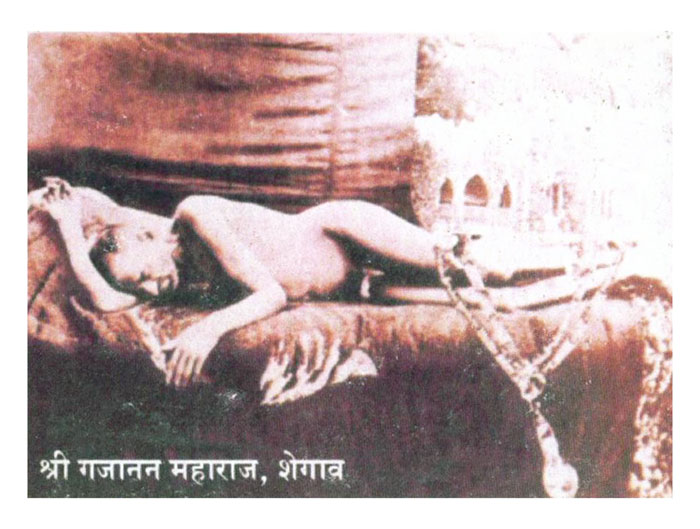
English translation of Adhyay 8. See the Glossary for special terms.
॥ Shri Ganeshay Namah ॥
1. O Vasudeva-Devakinandan, child Krishna — you alone shall remove our thirst.
2. Reveler of sixteen thousand women, yet you remain unattached. Knower of duty's karma, runner to the devotee's call.
3. Taker of Arjun's side, fighter for him, maker of him invincible, destroyer of the Kauravas.
4. Behaving with timely awareness, ever giving inspiration, protector of devotees — you truly prove helpful.
5. O Devakinandan, let your help be there for the writing of this book. Without your help, how shall I write?
6. Countless salutations to you. Let there be alliance with Saraswati, who causes the book to be written; thereby the work to fulfillment.
7. The avalia (the Master) instructs me; he saves me in various situations. As you were helpful to Arjun, so he proves to me.
8. The fallen Arjun — you alone made him stand; you convinced him of the importance of action; you immersed him in the inclination toward action.
9. As Arjun on the battlefield, so a situation in a moment. Many instructions occur; they impel me onward.
10. Krishna! Now you must run; impel me thus; let the Guru's command be obeyed; let life be made meaningful.
11. The importance of the command is convinced — by obedience to the command. Burdens become light, but the command is not obeyed.
12. One who obtains your help — his work is fulfilled. This certainty I have; thereby (I) rely on (you).
13. Again and again the entreaty: let me write the Guru's story; let words fall on the ear; thereby the pen shall move.
14. You tell all: do not practice hostility. As the fruit was for Kamsa, so is hostility for the practitioner.
15. Such was the case of the Deshmukhs — they had a relationship with hostile feeling. The Patils' rise: it irritated their eyes.
16. The Guru's grace upon the Patils was undeniably great. On the Patils' veranda, an infant began to dwell.
17. The Patils' fame did not really please the Deshmukh. The village Shegaon split in two; the path of enmity.
18. Two factions in the village — one Deshmukh, one Patil. Each one looking for trouble.
19. Pure inner mind was not in the Deshmukh's case; likewise the cast of his action — a cause for trouble.
20. Two parties in Shegaon — one Patil, one Deshmukh. How shall there be friendship between them? Always enmity between them.
21. They look for each other's flaws; (each waits) when authority comes to hand. When authority was with the Patils, the Deshmukhs would pick at them.
22. Such are these leaders. They never take part in the actual incident; they are clever.
23. They run far away; they give a push to others; they impel others; they revel in trouble-making.
24. Although the karma was indirect, it must still be borne. The leaders shall not escape it; karmic fruit must be borne.
25. Each must bear his own; no one comes to help. Therefore practice good karma, by which you become worthy of joy.
26. One becomes a power-holder because of others; this very power-holder forgets it. He becomes intoxicated by power; he undertakes wrong audacities.
27. When the Patil was at the pond, he met the Deshmukh's mahar. The mahar was the Patil's subordinate; the mahar had to obey.
28. The Patil ordered him: "Take the government document and go to Akola." The mahar refused.
29. Much back-and-forth occurred; in that, abuses too. Khandu became greatly enraged; he said: "The mahar has shown disobedience."
30. The mahar gave a refusal. The Patil became greatly enraged; anger became uncontrollable; he struck a club on the (mahar's) hand.
31. The mahar's hand was broken. The Deshmukh achieved his move; he took advantage of the opportunity; he filed a criminal case.
32. What shall the opposing party do? It catches just such a golden opportunity; it gives encouragement to others; it increases its own strength.
33. After Kukaji passed away, Khandu was running affairs. That irritated the Deshmukh; he would surely pull out the thorn.
34. He won over the constable; he embellished and told the situation; he made it large; he had the Patils declared guilty.
35. Otherwise the constable has no importance; in a criminal case his sway is supreme. By appeasing the constable, the soul is freed from torment.
36. Until the judge gives the verdict, the constable troubles the accused; he carries out his duty thoroughly; otherwise he ignores.
37. Here the same happened; the Patils became accused; the Patils understood all that was coming; the water from their mouths fled.
38. But when the Guru's grace is there, anguish becomes less. The Patils' burden was on the Master; they entrusted it to the Master.
39. A warrant was issued on Khandu Patil; the Deshmukhs became joyful; the next scenes began to appear; they began to see their kingdom of authority.
40. The Patils were frightened in heart; thorns became boils; nothing came to mind; brothers went to Akola.
41. They remembered Maharaj — only that remained now. The Patils set out at night for the temple; they placed their head at the Master's feet.
42. Khandu was very wicked by nature; in addition, the rope of authority in his hand. Action in a fit of anger — then much remorse.
43. Vighnaharta has compassion; that is why he is so called. Maharaj was Vighnaharta; the spring of compassion was bursting forth.
44. They held Maharaj's feet; Maharaj gave the blessing; he reassured Khandu; he embraced (him) with both arms.
45. "Go, don't fear in the least. Fetters shall not fall on you. The Deshmukh shall not prevail. You shall be released without blemish."
46. The Creator had decided Maharaj's living. The importance of past accumulation — accordingly was his living.
47. Important situations are determined; in facing them, other karmas occur, becoming the cause of further (karmas).
48. Who shall stop the Creator? Likewise the inclination toward action? Even the Master is not free from it — practicing various karmas.
49. At noon time, when the Master was peacefully asleep, a group of Telangi Brahmins came to Khandu's house.
50. They came to ask alms; they began to chant mantras; they began to look here and there; they began to speak loudly.
51. He at whose house the Master is — that household is at peace. Whoever comes — outsider — is never in fear.
52. The Master heard everything; corrected the mantra-chanting; awakened the sleepers. The Telangis were astonished.
53. The Master alerted them; warned them not to plunder. He had a flower-petal given (to them); he asked them to move on.
54. The Brahmins took the alms; stuffed them in their bag; took the road to the next house. This worked out for the better.
55. Correcting mistakes, putting on the right path — this became daily; no name of stillness.
56. One house alone is not the yogi's; day and night the rule does not run; never to be in one place; to seek a new home.
57. To keep changing one's stay; not to revel in splendor; such is a yogi — which was the Master's case.
58. The Master left from Khandu's; he came to Krishnaji's farm. Joy was great; smiles fixed on the cheek.
59. Where Maharaj shall go, just so it shall be. This was no hospitality; he wanted (to give) support.
60. One who depends on another — he alone wins his goodwill; gets the work done from him; makes life meaningful.
61. "Serve and eat the sweets" — this is a childhood teaching. Do service from the heart, by which you shall keep eating sweets.
62. Even if for the sake of sweets — good karma occurs at that moment. Sometimes it is not understood without the lure being shown.
63. The Master ordered Krishnaji: "Just give us a hut. Don't (let us be) in anyone's house."
64. Near the Shankar temple, arrangement for a hut was made. To stay for some days, the Guru-figure dwelt there.
65. Maharaj felt: I have avoided the trouble. But what is written in destiny is never averted.
66. The news became known in the village; all ran to the farm; they began to fulfill their motives; they began to take blessings.
67. The Master dwelt; the farmland became (sacred); the place's glory grew; flower-garlands and vows arose.
68. Along with the Master — Patil Bhaskar, Tukaram Kokate together — continuously in service.
69. The Master's leelas spread far. Sentimental devotees gathered; Krishnaji's farm bloomed.
70. Distant gosavis, with the motive of taking advantage, would come to Shegaon, citing the name of pilgrimage.
71. Among ten or twenty gosavis, Brahmgiri was the chief — pretentious in inner being, roaming in sadhu's garb.
72. The gosavi said to the Patil: "We have set out for pilgrimage; we go to Rameshwar; we shall bring (water) from the Bhagirathi.
73. For the propagation of dharma we wander village to village. In the heart, simple feeling — thereby scope for religiousness."
74. The gosavi said to Krishnaji: "Stay of three days. You appear to be wealthy at home. Feed us shira (sweet) and puri.
75. You feed the naked one; you keep the madman. We have come to give discourses, to awaken religiousness.
76. Stay should be at the farm. Order having been given to us, we have come this far. Quickly give us shelter."
77. Krishnaji said in reply: "This evening I shall listen to the discourse; then I shall give a feast of five-fold delicacies."
78. "Ganja is not less here; in tending there is no lack. He who stays as one of his own — his arrangement happens."
79. In the evening for the discourse, Brahmgiri took up Gita verses for explanation as the basis.
80. The discourse did not catch fire; the villagers did not get absorbed; they kept whispering; not a trace of (true) sadhu in him.
81. One by one became disillusioned; they began to return to the hut. Maharaj was on the bed; Bhaskar was near.
82. He was filling the chillum; Maharaj was in his own trance. The villagers were watching the whole matter; they understood in their minds.
83. The gosavi's crowd began to dwindle. The gosavi became angry; he was insulted.
84. One who has no austerity — what curse shall he give? The curse shall not prove true; nobody trembles.
85. One whose words are sharp — him alone they fear. Of mild words, none shall tremble.
86. Here near the Master, Bhaskar was in service; he kept giving the chillum to him from time to time.
87. From the chillum's fire, a spark fell — it fell exactly on the bed — but no one's gaze went to it.
88. After some time passed, smoke began to rise; slowly all around, flames began to rise indeed.
89. Bhaskar was near; he said: "Sadguru-Lord, don't sit here now," and began to take his hand.
90. In a moment the bed caught fire. Pandemonium broke out everywhere. Krishnaji too became frightened; as if his own bed had caught fire.
91. Bhaskar tried to make Maharaj rise; Maharaj would not move at all. Many entreaties — but the Master was not convinced.
92. Fire is among the five elements; the body too is among the five elements. Although fire practices its dharma, I shall not be afraid of it.
93. "I shall sit right here." The bed caught fire quickly; flames rose again and again, as if to consume the Master.
94. The Master said to Bhaskar: "Bring Brahmgiri to sit on the burning bed, to digest the Gita's principle."
95. The Guru's command became authority. He took Brahmgiri by the collar; brought the master before the Master. Brahmgiri's head bowed down.
96. Brahmgiri was a thorough hypocrite — know that; he was frightened in heart; he felt: let me run from here; sweat poured profusely.
97. He came to surrender to the Master; began to ask forgiveness. The Master instructed Brahmgiri: "Don't flaunt your learning.
98. Don't tell wrong things to the world. First do, then tell. Convince through action. Don't blabber pointlessly."
99. Brahmgiri said to the Master: "I am a belly-filling saint, in mere learning. I have not experienced anything in it.
100. I called you mad pointlessly; I spoke wrongful words; I revelled in five-fold delicacies; I wandered uselessly."
101. Once more the people made an entreaty to the Master. Hearing the devotees' entreaty, the Master got down at that moment.
102. When Gajanan got down, the bed collapsed. The remaining part — the people extinguished it.
103. At midnight time, he spoke to Brahmgiri: "He who has smeared ashes on his body — he should not practice pretense.
104. Master Swami Ramdas, Dnyaneshwar, Tukaram, Goraksh-Machchhindranath — know the principle (from them).
105. Don't roam the earth merely on learning; don't have ego in the heart; (don't have) slander, jokes, mockery."
106. The Master gave him a thorough ear-opening. He was convinced in his heart; remorse came to his mind.
107. "Don't stay at this place; if you stay, in a situation of disgrace, not having recognized the master, he shall beat you."
108. Brahmgiri was convinced; his eyes opened; he resolved to leave from there; he followed the next path.
॥ Shubham Bhavatu ॥
॥ Offered to Shri Ganapati and Saraswati ॥
॥ Thus ends the eighth chapter of Shri Guru Gajanan Leela Granth ॥