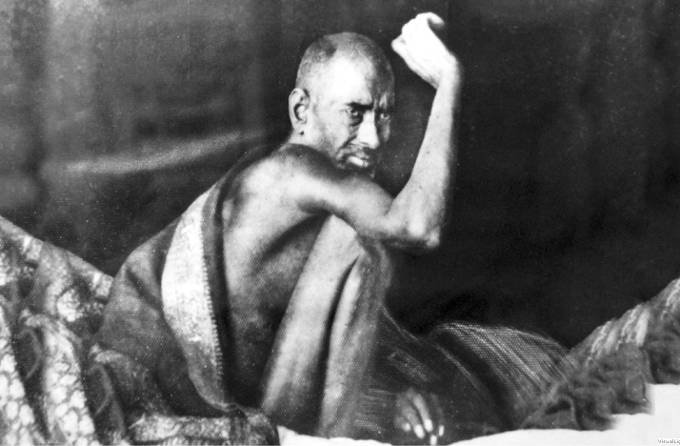
English translation of Adhyay 5. See the Glossary for special terms.
॥ Shri Ganeshay Namah ॥
1. Without water, life would become dry. To Varuna (god of water) — countless salutations.
2. Likewise, without grace — whatever is done in deed, whatever is written, would be mere construction of words.
3. Therefore Gana-Maharaj entreats: let there be your gracious blessing; let such a book be written that all should be amazed.
4. Let each one feel: let there be gracious blessing; let life become harmonious; let the heart's desires be fulfilled.
5. At Shegaon, around the Master, devotees were on every side. To please the Guru-figure, they made many efforts.
6. All around Gajanan — the Master had no peace; how could it sit well in his mind? He could not stay still.
7. One who is not enamored of people's praise, allured by public esteem — one who is by nature awake — how shall he fall down?
8. The Master began to evade the crowd; he avoided question-and-answer; he began to seek such a place where he might find solitude.
9. Go and stay anywhere; let there be no one's binding; live freely; never be confined.
10. He who follows this principle — for him no bondage of maya remains. He who has recognized maya — he alone has known the eternal and the impermanent.
11. Politicians make crowds; they gather rented people. The Master avoids crowds; he accepts solitude.
12. The Master could not bear crowds; this was clear from his actions. He never stayed in one place; he ran with the speed of wind.
13. One who has kept nothing of his own — what importance does he give to the crowd? No importance to praise, no importance to blame from people.
14. One who revels in Sat-Chit-Anand becomes absorbed in that; he stays in that very trance; he gives no importance to the crowd.
15. The Master evaded their gaze, left Shegaon's land, took the road to Pimpalgaon, took the path of the forest.
16. Blessed are the people of Pimpalgaon, who obtained Gajanan. The land became sacred when the Master's feet touched it.
17. Wherever the Master's feet are — there sat-sang (good company) occurs; relationship with good conduct forms; good qualities awaken.
18. In life, importance lies in sat-sang. Where sat (truth/being) is, how shall asat (untruth) endure? The two will not dwell in one place.
19. Sat + Chit + Anand — that is Sat-Chit-Anand. When consciousness is connected with truth, then alone is bliss obtained.
20. Where there is the company of truth, there the Lord dwells; thereby joy springs up of itself, comes running.
21. The soul has but one obsession: I must have the company of the Lord. Make such efforts that the Lord may be obtained for the soul.
22. Make such an effort that you join with the Lord, that the soul revels in that, that life is fulfilled.
23. By joining is bliss obtained; in that itself supreme bliss is met. Pleasure (sukh) and bliss (anand) — there is a great difference between these.
24. Pleasure has connection with sorrow; in one pleasure, many heaps of sorrow. Bliss has connection with the Supreme; when bliss comes, supreme bliss is at the door.
25. Pleasure is mixed with sorrow; bliss is mixed with supreme bliss. The Master recognizes this principle — therefore he proves to be the Master.
26. Those whose actions have power are called Master (Samartha). Common people commit wrongs; they waste time in vain.
27. They consider falsehood true; they consider truth false. All are allured by maya; all get entangled in maya.
28. That itself is untruth. Innumerable experiences come to be borne. On one action another action follows; from one mistake another mistake follows.
29. Knowing a mistake one can correct it. To whom does the mistake become known? He who knows the secret of life — he alone perceives the mistake.
30. One who is alert — how shall he remain unalert? By contemplation he stays alert; otherwise he becomes unalert.
31. One who maintains contemplation — he alone is vigilant. One who is vigilant has attention to the inner Self.
32. Maharaj knew the principle; he easily evaded the crowd; he left Shegaon, reached Pimpalgaon.
33. In the outskirts of Pimpalgaon, an old Hemadpanthi Shiva temple — in that temple, the Master sat in the sanctum.
34. He sat in lotus posture; awareness of time and place did not remain; he forgot hunger and thirst; nothing of the Master remained.
35. He was in samadhi state. Samadhi need not be undertaken; it comes upon (one in) oneness; oneness itself proves supreme.
36. All happens by past merit; good deeds add to it. Merit comes to bloom; its fruits are excellent.
37. Do good deeds in this life; their fruits should be enjoyed in the next. Practice such action that it proves to be a meritorious deed.
38. Do such karma that fruits of merit fall into your lap. Do not behave with bad conduct. Do not abandon this principle.
39. Karma's connection is with previous karma, with past accumulation. From one karma another shall arise; karmic fruit must be borne.
40. Let the past accumulation be such that the soul stays joyful. Let the accumulation not be such as causes the soul anguish.
41. The Master knows all; he revels only in good qualities; he practices only good deeds; he protects dharma.
42. The Master was in samadhi state, in a different trance, in a different bliss — what we cannot find in reading.
43. True bliss is in personal experience — not in mere description, not in mere reading, not in mere listening.
44. In life, personal experience has great importance. The law of nature being so, how shall the Master break it? Even the Master must do karma.
45. Between the Master's karma and our karma, there is a great difference: one is selfless, the other is in self-interest.
46. In selfishness comes downfall; in selflessness comes good destiny. By selfishness none crosses; in selfishness no meeting with the Supreme.
47. As is one's company, so are one's actions. Therefore stay in good company; thereby you shall stay in good qualities.
48. At evening hour, cowherds were coming home. On the way they peeped into the Shiva temple and saw the Master.
49. The children of Pimpalgaon gathered; they began to wake the yogi. The Master's trance was so deep that the children could not break it.
50. The children brought a flower-garland; they put it around Maharaj's neck. They placed a piece of bread for his meal. Each was eager to look.
51. The children thought: this being is hungry; he will eat the bread. They gave him water to drink. They began to do whatever came to mind.
52. Much time passed; the sun too set; darkness came. The children's hearts were drawn toward home.
53. The children were afraid of their elders; they had the pull of home. They took the road home; thoughts began to circulate.
54. Their feet went toward home; minds were caught in the Master. Feet went forward, but thoughts went backward.
55. The children returned home, awareness of body lost; forgetting hunger and thirst; each one was in this state.
56. The elders were waiting; the children returned home. They said the Shubhamkaroti prayer; meal time came.
57. What would they eat with relish? They were taking morsels by hand, eating with the mouth — but with different thoughts.
58. Attention would not focus on the meal; all noticed it. At night sleep would not come; their minds were not at peace.
59. Everyone's nature is not the same — like the five fingers of a hand. Each acted according to his nature.
60. Some told it at home; some hid it. They acted according to habit; they followed their basic nature.
61. Some had such upbringing that they could not speak in the home — that not everything is to be told at home was impressed on their minds.
62. The children went to sleep at night. Visions began to come before them. The Master's figure began to appear; sleep would not come.
63. Night ended; the sun came; daily routine began. He who knew the matter began to tell others.
64. Each was eager for darshan; he set out with the children. They came to the Shiva temple to see the Master.
65. Maharaj was sitting in the same place; the flower-garland was on his neck; the piece of bread, a quarter; water too in an earthen pot.
66. As seen yesterday, so seated today; he had not touched the bread; he had also forgotten hunger and thirst.
67. When the samadhi descends, this saintly being shall speak. Some said: "Bring a palanquin quickly; let us parade him through the village."
68. A palanquin was brought, decorated with flower-garlands; the Guru-Mother was placed in it; samadhi was not broken.
69. Men and women of the village raised the resounding of bhajan. To the rhythm of musical instruments, men and women began to dance.
70. The palanquin set out in the village; children and cowherds all around. With astonishment they began to say: "Such a figure we have not seen!"
71. The procession came to the village, to the Maruti temple. The Sadguru was brought there, seated in splendor.
72. That day too passed thus. People thought: "When will the samadhi descend?" People raised the resounding of the Name.
73. After some time, the Sadguru came to body-awareness. Joy came to all on placing their heads at his feet.
74. His samadhi descended. The Master was absorbed in name-repetition. His gaze went around; the devotee-fellowship watched.
75. Plates of naivedya came; they were offered to the Master. The news spread around; in no time a crowd gathered.
76. He who had avoided the crowd saw the crowd again. He could not avoid trouble — the leela of the Creator.
77. Before divine sovereignty nothing prevails — this proved true here. The Master could not avoid the crowd, though he had left Shegaon.
78. The residents of Pimpalgaon, on a Tuesday, went to Shegaon for the weekly market.
79. They went to the market and told the villagers: "Some naked Baba has come to our village, to Pimpalgaon.
80. No idea about clothes; he stays in his own trance; no clue about name and place; he just lies in his own trance.
81. Like a madman he stays; he stays in his own intoxication; nothing real is known; he tells no one.
82. He doesn't behave like a madman; he keeps mumbling with his mouth; he doesn't know how to scream; he doesn't strike children."
83. The news spread in Shegaon; topic of discussion in town. Who could this saintly being be? Curiosity in everyone's mind.
84. When Bankat learned, he could not sit still. Bankat was impatient to meet Maharaj.
85. In a moment the thought came: this is Gajanan's leela. He said: "Let us go to Pimpalgaon; let us see Gajanan."
86. He went to Pimpalgaon and began to look at the yogi. The shock of astonishment hit him; he could recognize Maharaj.
87. He stood before the Master, placed his head at the Master's feet, began to plead in many ways: "Come, Swami, to Shegaon."
88. Bankat had excellent training; thereby religious good conduct. He held Maharaj's hand — this was his life's support.
89. Maharaj said to him: "I am afraid of hospitality; I am afraid of your splendor; I do not want anyone's house.
90. Right and wrong don't suit us; feasts are not dear to us; pure feeling is dear to us; no shelter for worldly esteem.
91. Don't plead with me. Let me stay in Pimpalgaon. I don't want Shegaon. I am afraid of the crowd there.
92. Don't put me in bondage. We are by nature free of bondage. Don't get into trouble. You should revel in trade.
93. Stay with your wife; you should stay in worldly life. You befit household life; we are in yogic practice."
94. To take Maharaj back, a cart was brought to Pimpalgaon. Bankat pleaded with the villagers: "Let the Master come to Shegaon."
95. Maharaj was wanted by all — by the Pimpalgaonis as well as the Shegaonis. None would let him go.
96. Bankat said to the villagers: "Maharaj will stay at my house; he was at my house before, though today at Pimpalgaon.
97. This house is no longer mine; nothing is mine; my house is not a stranger; all has become Maharaj's.
98. You should come from time to time; meet Maharaj. But now let me take him; don't stop me."
99. The whole village was held back. He listened to no one; he seated the Master in the cart; he brought him to Shegaon.
100. The Shegaonis would not by any means let Maharaj go. Many kinds of entreaties the villagers made to him.
101. Maharaj's field of action — Shegaon is his very land. Although the land changed, the Shegaonis were not less.
102. What the Creator decides — how shall Maharaj change it? What is written in destiny shall prove true; sometimes it proves an exception.
103. The Guru-figure came to Shegaon; in no time the news spread; crowds began to gather again; the devotee-fellowship became joyful.
104. All began to say to Bankat: "Wow Bankat! You did marvelous! You sanctified Shegaon's soil; through you the Guru-figure was obtained.
105. Blessed, blessed are you, Bankat. Maharaj listens to you. Past merit alone in your lap, by which the Sadguru is obtained."
106. All were tending to him; everyone was at his service. Each wanted Maharaj — that's why they behaved so.
107. Live a life such that others want you. Become everyone's, but behave with detachment.
108. One who behaves thus is liked by all; his word alone is caught up; his word alone proves to be the support.
109. Daily new devotees, daily new questions. Taking the Guru's blessing, they were crossing over critical times.
110. Maharaj became a Shegaon-resident; the Shegaonis became filled with Maharaj. The sense of "self and other" disappeared; all forgot the "I."
111. Maharaj's company was obtained; thereby dimples bloomed on all faces. They began to consider him life's support; with faith they caught his words.
112. Where Maharaj stayed, joy took up residence. Each began to experience and tell others.
113. Each was hungry for joy; thereby they came for darshan. Otherwise who has time? Their faces' expressions began to speak.
114. Everything was running smoothly. The Shegaonis were happy in their hearts. The kingdom of joy was there; it depended on Maharaj.
115. Once again Maharaj evaded them; in the morning he set out for Adgaon. He ran with the speed of wind. None could stop him.
116. Maharaj was not just of Shegaon — he was of all. He was by nature solitary; he kept demonstrating from time to time.
117. He would run with the speed of wind; in no time he would become invisible; in no time he would appear again. All by the strength of yogic power.
118. By yogic leela he would go anywhere, lie anywhere; sometimes seen in meditation, sometimes seen sitting casually.
119. Stay not in one place — he who feels thus, how shall he accept Bankat's house? This the Master demonstrated through action.
120. A yogi can live without food and water — but not without divine sovereignty. He left Shegaon; he set out for Adgaon.
121. It was the days of Vaishakh month; the sun beat down; the yogi felt no scorching; he went with the speed of wind.
122. All around, trees and creepers were withered, ever short of water; they began to wilt with thirst; some had fallen.
123. No name of greenery; no shade as company; no grace of nature; no name of rain.
124. All a dry atmosphere; no sign of pleasantness. Sun-Narayan himself was spitting fire from his mouth.
125. All were scorched; the earth was not spared; the earth too could not bear it; the sun's rays were burning.
126. The earth was heated; it was burning hot; the limit of patience was reached; the limit of endurance ended.
127. One yogi felt compassion. For her sake he hurried. He entreated the Lord; he pleaded for the earth.
128. Maharaj felt thirst; he turned his gaze in all directions. Water turned its back on him; he just took the road ahead.
129. Apart from the water in the body, no provision for water was visible. The soul was distressed with thirst. Who would arrange for water?
130. Need is the mother of search. By merely saying "water, water," water won't come to hand; it won't be obtained without effort.
131. The Master looked here and there; water was nowhere to be seen. Without invoking, it is not obtained — only the yogi knows this.
132. One must invoke at the right time; the Lord must come running for the protection of the devotee — like a mother to the crying of her infant.
133. Just then his gaze went to a field. The Master was very clever by nature. There must be water in the field; without it cultivation cannot be done.
134. When a critical moment comes, call out to the Lord; he comes running on being called; he protects in the critical situation.
135. The Master looked at the field; he remembered the Lord. "Here we shall obtain water" — so he felt.
136. Maharaj went to the field. The owner, Bhaskar Patil, was toiling in the field, filling his belly.
137. He was from Akoli village. He told the matter of water: a drought of water in the village; everyone was searching for water.
138. Just like a politician's mere speech that keeps the people empty — so was Bhaskar's speech: no sign of water.
139. One who calls the splendor obtained "mine" is selfish; there is no moisture of love in him; he behaves cruelly.
140. One who considers all to be the Lord's gives to others. By giving, the store does not end; rather it grows.
141. Knowledge grows by giving; love grows by giving; devotion grows in benevolence; in selfishness there is loss.
142. One who practices these rules can live life; he proves blessed in life; he proves an ideal in life.
143. Recognize nature; know the divine principle; consider all as kin; do not say "mine, mine."
144. What would the ignorant Bhaskar know? He yokes oxen to the cart, does cultivation, fills only his own bag.
145. One who does not know the order of creation — how shall this principle be impressed? What is convinced through experience — that alone gets impressed on the mind.
146. Bhaskar was just like that. He said to the Master: "Don't ask us about water. There is no water in our village."
147. Maharaj said to Bhaskar: "What are you saying! Don't refuse water enough to drink.
148. I am distressed with thirst. Don't blabber pointlessly. Thirst is quenched only by water — not by speech."
149. What lessons would Bhaskar grasp? All is grasped only by personal experience. He who experiences the intensity becomes sober.
150. Experience of burning makes one feel the burn; the rest is dry preaching. He who is scorched in the situation knows the suffering of another.
151. Bhaskar said to the Master: "You look like a naked madman. Don't go to that well over there. There's no water in that well at all.
152. Where there is not a drop of water, how shall your thirst be quenched? It is a well only in name — bone-dry, truly."
153. Maharaj went to the well; there was not a drop of water. He stood for a moment; he cast a glance on the well.
154. He gazed steadily there; the well's consciousness was attracted. The water hidden in the well — in a moment it released it.
155. In the Master is power; in the strength of yogic power, the well filled in a moment. Give-and-take came into existence.
156. All goes by give-and-take; only what is sown sprouts; nothing goes to waste. This saying proves true.
157. In this life, sow such that it proves useful in the next life. What seed should be sown? Sow the seed of love, affection, benevolence.
158. The essence dawned on Bhaskar. By experience he was awakened. He came to surrender to Maharaj. He placed his head at the Master's feet.
159. He forgot wife and children, all means of livelihood. The whole mystery was understood; all foolishness was gone.
160. Bhaskar became Bhaskar (the sun); the thief of ignorance fled. When Bhaskar (the sun) rises, darkness can do nothing to him.
161. Such a Guru-Lord was obtained; Bhaskar's life became blessed. In the truest sense he held his feet; the Master knew through inner-knowledge.
162. The Master said to Bhaskar: "Plenty of water in the well; grow plenty of fodder for the field; plenty of water for cattle.
163. Your fortune has arisen; no one shall dry up the well; this is the means of livelihood; grow plenty of crop and fodder.
164. I am only the pretext, by which the well filled in a moment. Whatever is your past accumulation — that gathered together in a moment.
165. Bhaskar said in reply: "I have toiled in the field for nothing; nothing in my lap till today. With body alone I have run a household.
166. Thereby the burden of household life is felt; ever the disease of worry; thereby one becomes weary. Whom shall we tell all this?
167. All are scattered; all are despairing; all are tormented; the strength of the limbs is gone.
168. Who shall hear the wailing? Who shall give shelter? Each shall draw back; none shall give from his own.
169. All of us behave like this; we get entangled in worldly life. Guru, you alone have awakened us, by which we have come to our senses.
170. All have spurned me; I have borne karmic fruit. You alone have taken me close; my fortune has arisen.
171. I place my head at the Guru's feet. You alone are my mother and father; you alone are now the savior. I feel I should come with you now."
172. The Master, by yogic power, produced water; understanding came to Bhaskar. May it come to all alike — there itself the fifth chapter ends.
173. Gana-Maharaj says here: what is obtained by good company endures in life; thereby life becomes harmonious.
174. It needs the company of the Name; thereby worldly life is filled with the spiritual; karmic experience is not felt; the whole atmosphere is filled with joy.
॥ Shubham Bhavatu ॥
॥ Offered to Shri Ganapati and Saraswati ॥
॥ Thus ends the fifth chapter of Shri Guru Gajanan Leela Granth ॥