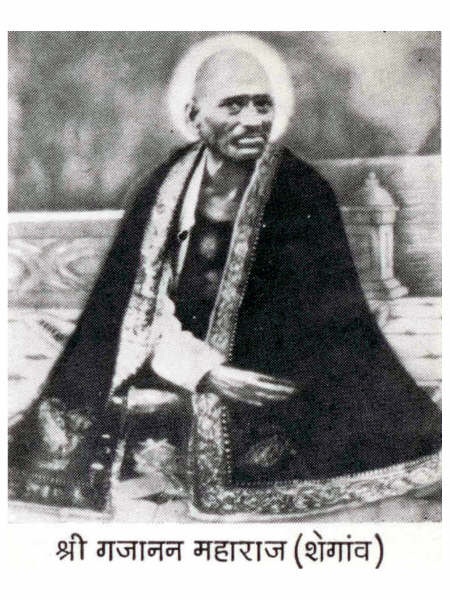
English translation of Adhyay 6. See the Glossary for special terms.
॥ Shri Ganeshay Namah ॥
1. The Narsimha avatar proved supreme; the devotee Prahlad was the cause; for the devotee's earnest longing, the Lord took form.
2. The Lord appears in various forms in manifest reality, in various circumstances, ever ready in protecting dharma.
3. When the burden of demons grows, when the earth is wearied, you take incarnation; you destroy the demons.
4. O Narsimha, O Lord, destroyer of demonic tendencies — save Gana-Maharaj now; let no trace remain.
5. In surrender all is obtained; in arrogance all is lost. By living with humble disposition, the divine principle awakens.
6. By the strength of experience, the devotee comes to his senses — like Patil Bhaskar, who came to know the essence of life.
7. Maharaj's devotees were many, but few were close. Bankat was one of those — humble and modest servant.
8. When the Master was in Bankat's house, at every step Bankat was attentive; whatever pleased the Master's mind — Bankat felt joy.
9. He was of greatly religious disposition. First to give to the Master, then to take himself — this was his daily practice.
10. He felt: the Master alone runs household life; he himself arranges everything. "Whatever he gives me, from that I keep some as naivedya."
11. First naivedya for Maharaj, then prasad for all. How shall he forget him? In forgetting, many adverse situations arise.
12. Many kinds of devotees, many kinds. Difficult situations for Maharaj. Even when the Master had no wish, he had to do many things.
13. Bankat insisted; he was stubborn about taking the Master to the field. He took the Master to the field to eat corn cobs.
14. Bankat felt: let the Master's feet touch the field, sanctify the soil, give grace and blessing to the family.
15. Bankat was pure by nature, under the umbrella of cultured parents, and along with that the Guru's grace, the umbrella of good company, family, friends.
16. Maharaj went to the field. Bankat became content. Along with friends and family he was called to the field.
17. Corn cobs in the field, seen here and there. A rich crop was emerging, swaying joyfully in the field.
18. A great large well, brimful indeed; around it tamarind trees, broad and stately, stood with grandeur.
19. They gathered under the tamarind tree. They decided to roast corn cobs. They began to light fires one by one — they lit ten or twelve.
20. The fires began to burn; flames began to rise; smoke also began to rise; it spread upward all around.
21. A honey-comb on the tamarind tree — no one had seen it. They began to light fires; that became the cause of the situation.
22. Fire burned below; it became unbearable for the bees. To save their lives, they began to fly about wildly.
23. They surrounded everyone; they began to sting them; nobody could sit there; one couldn't stand even for a moment.
24. Each began to run, began to guard his own life. He who was otherwise weary of life — here he began to save his life.
25. No one stopped for anyone; each began to run. They missed eating the corn; an adverse situation came.
26. The bees tormented all. What soul revels in trouble? All felt: let us be free of trouble. Each was in such an inclination.
27. All ran away, ran in fear. Maharaj was not afraid; therefore he stayed there.
28. Maharaj sat in his own bliss; not a trace of fear in his mind. But the bees did not let him go; they surrounded him in a moment.
29. To sting others is the bees' nature. They took shelter in that to save themselves — this was their motive.
30. The fault is not the bees'; the fault is of bad karma. The situation comes of taking life; (the bees) took shelter in that.
31. In life, karma has great importance; in life, the burden is on karma. Common men behave one way; uncommon men behave another way.
32. The bees sat on the back, sat all over the body; the bees' covering was on the body — as if given as a blanket.
33. They had not a moment's leisure; they began to sting the Master. Who would stop them? All were afraid of them.
34. The Master's endurance — extraordinary calmness — never had been experienced in essence. The bees no longer feared.
35. Maharaj said to the bees: "You sting us; we shall not be troubled. We know one principle.
36. The soul is not separate — yours and ours. To sting others is your dharma; practice your nature's dharma; protection is our dharma."
37. The common one acts tit-for-tat; the uncommon one acts the opposite. He does not abandon his own principle; he does not harm anyone.
38. The Master behaves uniquely. By disposition itself he proves Master. He does not even wish ill upon enemies; he wishes the welfare of all.
39. He gives no importance to himself; he immerses others in joy; he gives no importance to calamity; therefore no sorrow falls in his lot.
40. At last the bees grew weary; they left from there; they fled far away; they entirely forgot to play their tricks.
41. Bankat learned the matter; he became frightened in heart; he was confused in a moment; many kinds of thoughts in his mind.
42. The friend-fellowship with him went to his field; doctors too were along, to do treatment and medical care.
43. Bankat hurried forward; he began to ask Maharaj's pardon; his heart began to speak; he wiped tears from his eyes.
44. Stings stuck in Maharaj's back — Bankat himself saw. The mind became sorrowful: "I have brought the Master here pointlessly."
45. The doctors examined him; they made arrangements to remove the stings; they began to apply tweezers to his back; began to remove the stings one by one.
46. The Master said to Bankat: "The stings stuck in my back have not tormented us; they just went and sat there.
47. By yogic strength I shall remove the stings; we don't want your tweezers." The Master concentrated his yogic power; with that the stuck stings came out.
48. Bankat was moved; goose bumps came on his body; he held the Master's feet; he said: "Don't take such risks."
49. To assure the Guru is not within everyone's reach; only one whose mind has the feeling of "ours" — awakened, intense feeling.
50. One who behaves thus proves blessed in life. Surface-level remains surface-level; the inner welling-up proves powerful.
51. Maharaj's nature was whimsical; whatever was in his mind, he practiced; he ran like the wind; he didn't stay in anyone's house.
52. So once it came to his mind. He evaded everyone's gaze. In a moment he left Shegaon; he ran with the speed of wind.
53. He went to Akot to meet Narsing. Like meets like — its importance is not understood by another.
54. Narsing was a devotee of Kotsha Ali; he was a devotee of Vitthal. He who reveled in Vitthal appeared, on the surface, to be in worldly life.
55. He truly reveled in devotion. Without devotion he felt dejected. The soul does not revel in dejection; it asks only for pleasantness.
56. The devotee is never in dejection; the devotee is always in pleasantness, in an auspicious atmosphere, in a pure atmosphere.
57. Worldly people are afraid of devotion; they get entangled in worldly life; they weave threads of thoughts; they get caught in that very web.
58. Understanding becomes misunderstanding; he imitates others; he behaves like the average; he himself causes his own destruction.
59. "Imitate others" is a saying — and this teaching is false. It makes the trouble greater; thereby calamities upon calamities.
60. Each soul is different; each constitution is different; the past accumulation is different — this comes to experience.
61. As is one's past accumulation, so the fruit one must bear. Each one's is different; new karma adds to it.
62. All this is common life. Narsing's life was different. He attained all while staying in worldly life; he did not leave it.
63. On the path of karma, devotion, yoga — talk went on through the night; not on slander of others, not on self-praise or ego.
64. Slander of others saves no one; don't be drawn into another's wife. Such karma proves poisonous; never useful in household life.
65. Poison proves a cause of destruction. Don't, don't have bad conduct. That invites Time; that brings a fear-filled life.
66. The Master said to Narsing: "You are well in worldly life. We have reveled in the path of yoga. How shall we revel in worldly life?
67. I shall not stay still; you are stable in worldly life; you are stable in the path of action; I am stable in the path of yoga.
68. Although our fields are different — like two eyes of one body. One has the field of action; the other has the field of yoga.
69. You and I are different in body, but we are of one thought. Our work was assigned by the Creator according to past accumulation."
70. The news of the two meeting reached the villagers; they became joyful, eager for blessings; they decided to meet both.
71. The Master knew through inner-knowledge; he said to Narsing: "We don't want the trap of trouble." He avoided the meeting.
72. Maharaj set out at dawn itself; he disappeared from Akot village. The villagers came to meet him, but all were despondent.
73. The meeting of two saints was not in destiny. Destiny proved supreme; the efforts proved in vain.
74. The villagers became dispirited; the flower-garlands in their hands remained as they were. What was not written in their fortune — that came to experience here.
75. Even objects must have fortune — this saying proves proper. Not every flower blooms that lies at the Lord's feet.
76. The motions of karma are deep; the foolish do not know this. Karma alone gets primacy; people are not free without bearing karmic fruit.
77. Such are the Master's wonders — what shall Saraswati not describe? The greatness of the saint's name — the Name on everyone's lips.
78. Saraswati shall describe the glory of the Name — she who shall become joyful; she who experiences bliss — she alone shall give it to others.
79. Fortune does not arise of itself; one has to make efforts for it. There is no success without effort — this comes to experience.
80. In snatching another's pleasure, nothing is obtained; it never endures; all proves in vain.
81. Earn such that Sat-Chit-Anand is pleased; never eat the unrighteously-gotten; do not nourish the body with that.
82. Who behaves like this? He whose mind is pure. In his mind reside pure thoughts; thereby alone good actions occur.
83. Mere worship is of no use; importance lies in mental disposition; importance lies in pure mind; thereby alone scope for good deeds.
84. A pure motive is needed in the mind; thereby behavior accordingly. In whose mind is pure motive — there are no quarrels and deceptions.
85. Where there is purity, how shall impurity endure? Where there is no impurity, there is pleasantness.
86. Where impurity is uprooted, there is auspicious atmosphere; there is pleasant atmosphere; thereby Sat-Chit-Anand arrives.
87. Live life in such a way that it serves as instructive to others. Don't have dry preaching; make it meaningful through action.
88. Such should be your disposition that it endures long in people's hearts; have a benevolent disposition; consider this itself worship of the Lord.
89. One does not become so by mere learning; it must come into practice; it must come into spontaneity; spontaneity must be there at root.
90. Those people who know spontaneous feeling — they alone live in the true sense. Those whose merit is in their lap — for them spontaneity in life.
91. Maharaj wandered spontaneously; wherever it came to mind, he roamed. Once with disciples in Daryapur, near Shivar village.
92. Vrajbhushan, the pandit there, with reputation and learning in his lap, knew four languages, was an expert in the Vedas.
93. When the Master came here, Vrajbhushan was looking at him. He said: "This is essentially a yogic person; the head should be placed at his feet."
94. He who daily offered arghya (oblation) to the sun, who kept daily observance, who knew the importance of austerity, who lived with devotional feeling —
95. he recognized the Master. He said: "Sun-Narayan himself has manifested. Today fortune has arisen." He offered arghya to Maharaj.
96. Importance lies in the heart's feeling; in practicing action accordingly. As the feeling in the heart, so the scope for action.
97. Who shall stop it? The Master was considered Sun-Narayan; in the truest sense the principle was understood; behavior was accordingly.
98. Vrajbhushan made twelve salutations; the feeling in his heart took form. The feeling that is formless — that very thing takes form through action.
99. He was already accomplished in Vedic recitation; in addition Gajanan was obtained. On obtaining the gracious feet — blessed, blessed became Vrajbhushan.
100. As a mother takes her child near, the Master held Vrajbhushan thus.
101. He gave a great blessing: "Child, may there be your praise. You shall reach the summit of fame; you shall become immortal.
102. Don't abandon karma-yoga; don't consider rituals meaningless; don't get caught in them; don't fear calamity.
103. Now go to your home; keep my words in your ear; by practicing the path of action, you shall be blessed in life."
104. He gave him a coconut; Vrajbhushan became joyful; austerity bore fruit; fortune arose.
105. As Vrajbhushan's fortune arose, may it arise for us in the same way. Gana-Maharaj prays to gods and goddesses: may all obtain the gracious blessing.
106. By whose grace this description was made — to all of them, countless salutations. I feel I should content the devotee-fellowship — this is the prayer in my heart.
॥ Shubham Bhavatu ॥
॥ Offered to Shri Ganapati and Saraswati ॥
॥ Thus ends the sixth chapter of Shri Guru Gajanan Leela Granth ॥